Select a site alphabetically from the choices shown in the box below. Alternatively, browse sculptural examples using the Forward/Back buttons.
Chapters for this volume, along with copies of original in-text images, are available here.


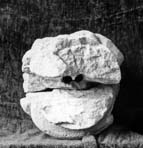
Object type: Capital with part of shaft
Measurements:
H. (overall) 36 cm (14.1 in); (capital) 17 cm (6.7 in); (collar) 6 cm (2.4 in); (column) 13 cm (5.1 in)
Diam. (capital) 24 < 25 cm (9.4 < 9.8 in); (collar) 25 cm (9.8 in); (column) 19 < 19.5 cm (7.5 < 7.7 in)
Stone type: Yellowish grey (5Y 8/1) sparry matrix supported oolite with many hollow ooliths which range in size 0.2 to 0.5 mm. Cleeve Cloud Member, Birdlip Limestone Formation, Inferior Oolite Group, Middle Jurassic. Probably from Bredon Hill.
Plate numbers in printed volume: Ills. 713-20; Fig. 21E
Corpus volume reference: Vol 10 p. 372
(There may be more views or larger images available for this item. Click on the thumbnail image to view.)
Capital with part of integral, slightly bellied shaft. The capital is cone-shaped above a collar carved with a bold cable- or rope-moulding. Three-quarters of the capital is covered with an alternating composition of acanthine leaves, the back face being left plain. The collar has also been left plain on the back face, although the plain section is slightly out of alignment with the plain section of the capital. The stone is broken vertically along a drilled fixing hole about 2 cm in diameter. A second, probably abandoned, vertical fixing hole has been drilled beside the first but does not go right through the stone. A third fixing hole has been drilled at an angle upwards through the blank back face and out through the top of the capital.
(including contributions from J. West)
The capital is beautifully carved and seems strangely at odds with the crude animal heads from the church. This might suggest that it was part of a church to which the animal heads were added a little later. Although this type of acanthine ornament remained in sporadic use until the turn of the twelfth century (e.g. the belfry capitals at Langford, Oxfordshire — West 1993, figs. 15, 16; Tweddle et al. 1995, 215, ills. 298–305), the deep eyelets and rather fleshy leaves are more like the acanthine ornament of the tenth century, such as the imposts from Avebury, Wiltshire (Cramp 2006, 201, ills. 395, 396) and Peterborough, Huntingdonshire, or the nielloed base of the Canterbury censer-cover (Backhouse et al. 1984, 89, 130–1, nos. 73, 137). In manuscripts, examples occur in initial letter and frame fillers such as that in the hoop of the initial 'P' of the Cambridge, Corpus Christi, Lives of St Cuthbert (fol. 6), or the frames of the early folios of the Benedictional of St Æthelwold (Temple 1976, 37–8, cat. 6, ill. 18; West 1993, 258–61; Deshman 1995, 236–7, figs. 169–76, col. pls. 1–3).
