Select a site alphabetically from the choices shown in the box below. Alternatively, browse sculptural examples using the Forward/Back buttons.
Chapters for this volume, along with copies of original in-text images, are available here.


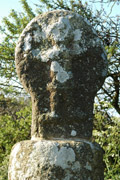
Object type: Cross-head and part of -shaft
Measurements: H. 72.5 cm (28.5 in); W. 49 cm (19.3 in) (head), 31.5 cm (12.4 in) (shaft); D. 22.5 cm (8.1 in)
Stone type: Coarse-grained Land's End Granite (A.V.B.)
Plate numbers in printed volume: Ills. 287-8
Corpus volume reference: Vol 11 p. 232-3
(There may be more views or larger images available for this item. Click on the thumbnail image to view.)
Cross-head and shaft of rectangular section, mounted on a modern base comprising a granite roller, millstone and cider press. The simple round-headed cross bears a relief-carved Crucifixion on one face of the head with a carved cross on the other and no other decoration.
A (broad): On the cross-head is an erect, forward-facing figure of Christ, with legs extending onto the shaft. On the figure's head, slight hollows may indicate eyes and mouth. The horizontally-extended arms are expanded at the ends and merge with the edge-moulding. The out-turned, over-sized feet reach almost to the edge of the shaft.
B and D (narrow): No trace of any ornament
C (broad): On the head is a cross, type B6, with arms only slightly expanded at the ends. The ends of the arms are not indicated: they simply merge with the edge-moulding. The cross and edge-moulding are formed by sinking four triangular areas, with a boss at the centre of each. In the lower half, the triangular areas are elongated, giving the cross a slightly oval frame.
Appendix D item (continuing tradition)
Two crosses very similar to this exist in St Buryan parish, at St Berian's church (St Buryan 3, Ills. 285–6) and at Trevorgans (St Buryan 5, Ills. 289–90). The Crucifixion on all of these is similar, and all are similar to, but simpler than, that on St Buryan 1 (p. 126, Ills. 29–32), a member of the Penwith group of early medieval sculpture. Thomas has suggested that the three simpler crosses may have pre-dated and provided models for St Buryan 1 (Thomas, A. C. 1978, 78–9), but for a number of reasons it seems likely that the influence was in the other direction. Firstly, while their Crucifixions are indeed all very similar, that on St Buryan 1 is more realistic, more detailed and better proportioned. By comparison, the others are stylised and simple, suggesting copies. Secondly, the form of the crosses on St Buryan 3, 4 and 5 are comparable to the Early Geometric designs used on cross-slab grave-covers after the Norman Conquest (Ryder 1991, 50–1). Thirdly, the round-headed shape of St Buryan 4 (Boskenna) and the majority of Cornish wayside crosses is likely to be based on a simplification of ring-headed crosses like St Buryan 1. In the spaces between the cross-arms, the bosses on the Boskenna cross appear to be derived from the bosses seen on St Buryan 1, but here they are used decoratively and not in a way that reflects their original function in pinning the cross-arms to the ring. And finally, if St Buryan 3, 4 and 5 are to be dated to the ninth or early tenth century, this assumes a very early start for the entire group of Cornish wayside crosses: a date for which there is no real evidence.
The Boskenna cross is located on a road leading to St Buryan parish church and on an area of former downland on the south side of the parish (Preston-Jones and Langdon, Andrew 1997, 111–13).
