Select a site alphabetically from the choices shown in the box below. Alternatively, browse sculptural examples using the Forward/Back buttons.
Chapters for this volume, along with copies of original in-text images, are available here.


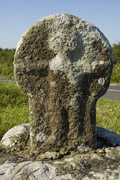
Object type: Cross-head and part of -shaft
Measurements: H. 69 cm (27.2 in); W. 50 cm (19.7 in) (head); 35 cm (13.8 in) (shaft); D. 20 cm (7.8 in) (head), 17 cm (6.6 in) (shaft)
Stone type: Coarse-grained Land's End Granite (A.V.B.)
Plate numbers in printed volume: Ills. 289-90
Corpus volume reference: Vol 11 p. 233-4
(There may be more views or larger images available for this item. Click on the thumbnail image to view.)
Cross-head and shaft of rectangular section, cemented onto a modern two-step granite base. The full length of the shaft shown in Langdon's drawing is no longer visible (Langdon, Arthur 1896, 128–9 and fig.). The simple round-headed cross bears a relief-carved Crucifixion on one face of the head with a carved cross on the other and no other decoration.
A (broad): On the cross-head, carved in low relief, is an erect, front-facing figure of Christ, with legs extending onto the shaft. There is no trace of any features or halo. The arms are outstretched horizontally. The bottom of the rib cage is visible, suggesting that Christ is wearing a loin-cloth, although this is not clear. The legs are slightly apart and the feet out-turned.
B and D (narrow): No trace of any ornament
C (broad): Both head and shaft are occupied by a long-shafted cross carved in low relief. The top vertical arm is thick and slightly splayed; the horizontal arms, which extend to the edge of the stone, are narrower at the centre with expanded ends; the thick bottom arm and shaft merge.
Appendix D item (continuing tradition)
It has been suggested that this cross, along with St Buryan 3 and 4 (Ills. 285–6, 287–8) might date to the late ninth century and be the forerunners of the Penwith group of pre-Norman sculpture (Thomas, A. C. 1978, 78–9). However, for a number of reasons explained more fully under St Buryan 4 above, that argument cannot be sustained. St Buryan 5 is a simple wayside cross with decoration derived from the churchyard cross, St Buryan 1 (p. 126, Ills. 29–32), not the other way round. The form of the carved cross can be compared to that on the medieval cross-slab grave-cover from Calverley, Yorkshire (no. 4), dated by Ryder to the twelfth century (Ryder 1991, 17).
Russell suggests that the former location of the cross was at No Man's Land (Russell 1971, 83). Here it would have stood on a road leading north from St Buryan church, at a junction of several paths and tracks, and on the edge of an area of former downland (Preston-Jones and Langdon, Andrew 1997, 111–13).
