Select a site alphabetically from the choices shown in the box below. Alternatively, browse sculptural examples using the Forward/Back buttons.
Chapters for this volume, along with copies of original in-text images, are available here.


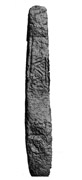
Object type: Cross-shaft and part of -head, in two pieces
Measurements: H. 173.5 cm (68.4 in); W. 53.3 > 46 cm (21 > 18.1 in); D. 50.5 > 46 cm (19.9 > 18.1 in)
Stone type: Coarse-grained granite. Feldspars, which form about 60% of the rock up, are up to 7 x 2 cm; equidimensional quartz crystals are up to 1 cm. There are a few flakes of dark mica, together with some tourmaline intergrowth. Land's End Granite
Plate numbers in printed volume: Ills. 65-72, 75-8
Corpus volume reference: Vol 11 p. 142-3
(There may be more views or larger images available for this item. Click on the thumbnail image to view.)
Rectangular cross-shaft in two pieces with part of head only, the head having been trimmed to roughly the same width as the shaft and the top broken off. The bottom of the shaft is undecorated and tapers to a rounded end which was presumably inserted into a socket or directly into the ground.
A (broad): On the cross-head is a badly worn and mutilated figure of Christ. The head and ends of the arms are missing. The feet are turned out but no other features are identifiable. There is no break between the figure and the decoration: the figure stands on top of the interlace. On both pieces of the shaft is a single panel of decoration within an incised edge-moulding. The decoration is a simple double-strand type F interlace, irregularly laid out and constructed of broad, shallow-carved bands. The pattern is not properly finished at the top.
B (narrow): No decoration is visible on the cross-arm which has been trimmed off, although part of the lower hole piercing the ring-head is visible. On the upper part of the shaft a small section of a diagonal key pattern is visible, possibly of the same type as on side D.
C (broad): There is nothing visible on the upper piece. On the lower piece, an incised edge-moulding is visible along the full length of the panel. Inside this are traces of an unidentifiable double-strand interlace pattern.
D (narrow): No decoration is visible on the cross-arm which has been trimmed off. Part of the hole of the ring-head is visible. An incised line marks the top of the panel on the shaft which contains a worn diagonal key pattern, possibly Romilly Allen's no. 926, the Welsh N2 (see Fig. 19c, p. 72).
This cross is a member of the Penwith group of pre-Norman sculpture characterised by a Crucifixion on one side of the ring-head and five bosses on the other (Chapter IX, p. 88). No bosses survive on this mutilated monument, but it has decorative features in common with other members of the group, namely the key pattern (also on Sancreed 1, Ill. 217) and the double-strand type F interlace (also on Gwinear 1, Ills. 94, 96). The poor condition of the stone makes detailed comparison difficult, but the small size of the monument and the neat Crucifixion are comparable with Gwinear 1, originally located only 7.5 km or 4.6 miles away.
With a place-name in *lann, a dedication to a Celtic saint (of possibly Irish origin: Padel 1988, 82), and a curvilinear churchyard located in a valley bottom at the lowest crossing point on the River Hayle, before it broadens to an estuary, St Erth is a site of early medieval origin. However, this cross and St Erth 2 are the only tangible remains of the pre-Norman period (Padel 1976–7; Padel 1985, 142).
