Select a site alphabetically from the choices shown in the box below. Alternatively, browse sculptural examples using the Forward/Back buttons.
Chapters for this volume, along with copies of original in-text images, are available here.


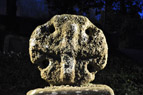
Object type: Cross-head
Measurements: H. 61 cm (24 in); W. 68.5 cm (27 in) (max.); D. 18 cm (7 in)
Stone type: Coarse-grained granite. Feldspars, which form about 60% of the rock, are up to 7 x 2 cm; equidimensional quartz crystals are up to 1 cm. There are a few flakes of dark mica, together with some tourmaline intergrowth. Land's End Granite
Plate numbers in printed volume: Ills. 73-4, 79-80
Corpus volume reference: Vol 11 p. 144
(There may be more views or larger images available for this item. Click on the thumbnail image to view.)
Head and a very short section of the top of the rectangular shaft. The cross-head has arms of type E8, with wide arm-pits and slightly curved ends. The arms are linked by a slightly recessed ring, type a. There are faint traces only of an incised edge-moulding around the edge of the cross-head.
A (broad): On the cross-head is a truncated figure of Christ. Christ is without a halo and has an unusually thick neck which curves outwards to the arms. The horizontal arms reach right to the edge of the cross-head; a slight broadening of the arms at the ends probably represents the sleeves of a tunic. A very slight depression at the waist may represent the top of a loin-cloth or a belt. There are no legs and the figure does not appear to have extended onto the shaft (unless the shaft has been mutilated at this point).
B and D (narrow): No trace of any ornament
C (broad): On the cross-head are five bosses, slightly irregularly placed, with one in the centre and the other four not central within their respective cross-arms but more in line with the holes between cross and ring.
This cross-head belongs to the Penwith group of pre-Norman sculpture characterised by a Crucifixion on one side of the head and five bosses on the other (Chapter IX, p. 88), but its very worn condition makes close comparison difficult. In so far as it is possible to tell, the figure appears more crudely carved and less well proportioned than Gwinear 1, St Buryan 1 and St Erth 1 (Ills. 92, 29, 66–7) and may therefore be a slightly later copy of these.
[1] This reference is probably to St Erth 2.
[2] This reference is probably to St Erth 2.
[3] It is not certain whether this reference is to St Erth 1 or St Erth 2.
