Select a site alphabetically from the choices shown in the box below. Alternatively, browse sculptural examples using the Forward/Back buttons.
Chapters for this volume, along with copies of original in-text images, are available here.


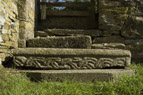
Object type: Part of cross-shaft
Measurements: H. 130 cm (51 in); W. 21 > 20 cm (8.5 > 8 in) (carved face); D. 26 cm (10.25 in)
Stone type: Coarse-grained granite with feldspar megacrysts up to 1.5 by 0.8 cm forming about 70% of the rock set in an equidimensional mix of white feldspar and quartz crystals up to 8 mm across. There is some tourmaline intergrowth, together with fragments of white mica up to 2 mm across. Bodmin Moor Granite
Plate numbers in printed volume: Ills. 241-2
Corpus volume reference: Vol 11 p. 207-9
(There may be more views or larger images available for this item. Click on the thumbnail image to view.)
A small section of the shaft of a probable cross. Only one carved face survives, but on this the decoration is well carved in reasonably high relief. Of the remaining three faces, two have been dressed smooth and the last is rough.
A (narrow):Within a single broad edge-moulding, is double-strand interlace. As the shaft has been cut longitudinally it is not possible to determine the pattern, however the regularly repeating pattern may indicate a simple plait. There is a clear moulding framing the pattern at the one end (the end with the tenon) and a hint of the same at the other, suggesting that the pattern is set within a panel, although the interlace is not tidily finished and strands at both ends appear to run into the moulding.
B (broad): This side is assumed to be an original face of the monument since it adjoins the edge of the carved face with the edge-moulding, whose rounded corner blends into this face. The surface has been dressed smooth and there is no evidence of any decoration.
C (narrow): Roughly cut and unworked; probably not an original face of the monument.
D (broad): Dressed smooth; probably as a result of re-use of the stone.
E (end): At one end of the stone are the remains of a broken tenon, the surviving section measuring 17 x 9 cm and just over 2 cm long.
When originally found, there was some doubt over the authenticity of the stone. Its location at a farm is unusual for monuments of the early medieval period and the fact that, if it is a cross-shaft, one face which should have carving on it (face B) is smooth, adds further to the uncertainty. Although the decoration is of early medieval type, it was at first mooted that the stone might be part of a Victorian memorial. In favour of a more ancient origin, however, are the facts that the fragment appears to be carved from surface and not quarried granite (unlike most Victorian monuments), and that the carving, though well preserved, is not as smooth and crisp as might be expected on a monument of recent origin. As the stone has been cut up for re-use, it is possible that the smooth faces were dressed flat for its secondary purpose. As the stone is sitting on a concrete plinth at the bottom of a short flight of steps of recent origin, its current location is unlikely to reflect its first alternative re-use. However there is no indication of what that may have been.
Accepting (tentatively) the possibility of an early medieval origin, the existence of a small piece of tenon on the end of the fragment helps to confirm that this piece is probably part of a cross-shaft. The fact that the edge-moulding narrows slightly towards the end with the tenon, and that the decoration becomes a little more worn in appearance at this end, may suggest that the fragment was from the top of the shaft and the tenon was for fixing the head. The surviving decoration is so limited that it is difficult for meaningful comparisons to be made. Double-strand interlace is common in monuments of the Penwith group (Chapter IX, p. 89), and only a few parallels can be found in mid Cornwall, where it appears on the head of Cardinham 1 (Ill. 45) and on the main faces of shafts at Lanivet and Quethiock (Ills. 117, 207), while Padstow 3 (Prideaux Place) has a triple-strand pattern (Ill. 169). On Quethiock 1, the double-strand pattern is an angular plait, divided from another pattern by a flat-band moulding. Quethiock is also said to have had tenons for fixing the head and the monument as a whole into a base (p. 196). It is not possible to be sure how much of the width of the shaft of Warleggan 2 survives, but the surviving decoration on face A suggests that perhaps a third or less of the original width is now seen, making a shaft width of possibly 60 cm (24 in).
Unexpectedly, it is the location of this probable cross-fragment which gives further reason to allow that it may be of early medieval origin. Trengoffe is 0.76 km (less than half-a-mile) from Carne, the deserted settlement where another fragment of cross-shaft was found (Warleggan 1, now at Glynn). It seems a reasonable possibility that both were once part of the same monument — a monument which, it is suggested (see Warleggan 1 discussion, p. 207), may originally have been located beside the east–west ridgeway which lies between the two holdings of Trengoffe and Carne. Supporting this relationship is the remarkable fact that both fragments are of exactly the same length, suggesting that they may have been cut from the same segment of shaft. Since they have different decoration they would have come from different faces of the original. The possibility therefore exists that an original monument was broken up, probably in the post-medieval period, and taken for re-use on farms in the neighbourhood. Although this idea is by no means certain, the geology, despite very minor differences, is not against the idea that these two stones, as well as Warleggan 3 (see below) may all have been part of the same monument. The context and significance of the original monument is discussed further in the entry for Warleggan 1 above (p. 207).
At Trevorder in Warleggan, 1.5 km (just under a mile) from Trengoffe, is a substantial cross-base with a mortice whose dimensions suggest it would have been capable of supporting a large and impressive monument (Warleggan 3, see Appendix A, p. 228, Ill. 280). The Trevorder base has also been re-used, in this case as a gatepost, suggesting that it too could have been acquired for alternative use when the original monument was broken up, although its greater distance from the proposed original location may militate against this.
As the Warleggan 2 stone is only a small fragment, it cannot be closely dated in its own right, but comparison with Padstow 3 and Quethiock, and its probable relationship with Warleggan 1, are considered indicative.
Finally, it should be noted that there is an interesting coincidence between the brief description of a lost stone, Cardinham 2 (see Appendix C, p. 229), and Warleggan 2, which raises a remote and strange possibility regarding the origin of this stone. If for some reason Cardinham 2 had been moved the 3.6 km (2.2 miles) from Cardinham to Trengoffe after the bombing which had revealed Cardinham 2 as the edging of a grave, then there may be every reason to see Warleggan 2/Cardinham 2 as a modern fragment. Hidden from view as the kerb of a grave, the fragment could have been a reject from a stone mason's yard, a broken section of a modern memorial cross, sensibly re-used and its origin hidden by re-dressing it and turning the carved face inwards. In this case, the differences between Warleggan 1 and 2 do not need explaining.
