Select a site alphabetically from the choices shown in the box below. Alternatively, browse sculptural examples using the Forward/Back buttons.
Chapters for this volume, along with copies of original in-text images, are available here.


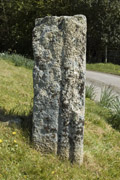
Object type: Part of cross-shaft
Measurements: H. visible 95 cm (37.5 in); W. 34 > 31 cm (13.5 > 12.3 in); D. 40.5 > 37 cm (16 > 14.5 in)
Stone type: Coarse-grained granite with feldspar megacrysts up to 2 by 0.5 cm forming about 70% of the rock, set in an equidimensional mix of white feldspar and quartz crystals mostly less than 1 cm across; a few of the quartz crystals range up to 1.5 cm. There is some tourmaline intergrowth, together with fragments of white mica up to 3 mm across. Bodmin Moor Granite
Plate numbers in printed volume: Ills. 238-40, 391; Fig. 20b
Corpus volume reference: Vol 11 p. 206-7
(There may be more views or larger images available for this item. Click on the thumbnail image to view.)
Part of the shaft only survives, and this has been cut down the centre of the main face. The shaft is currently mounted upside down, and buried about 33 cm (13 in) in the ground, so that some of the decoration recorded by Henderson and by Ellis is no longer visible and cannot be checked (Henderson, C. 1928, 108; Ellis, G. 1952–3c, 58; see Ill. 391).
A (broad): Within a double edge-moulding there is a panel of interlace, executed in broad, shallow bands. Because the shaft has been cut, it is not possible to determine the pattern-type.
B (narrow): Cut face with no decoration
C (broad): Within a double edge-moulding is a panel of interlace. Because the shaft has been cut and the decoration is worn it is not possible to determine the pattern, although plain plait is a possibility.
D (narrow): Within a single roll-moulding, there are now visible three volutes of a tightly coiled running spiral-scroll with pellets, buds, and in one case a pair of small leaves, in the spandrels. Now invisible beneath the ground is a simple '8'-shaped motif on its side (either a simple two-strand plait or a fret, the Welsh J4 – see Fig. 19b, p. 72), and above this part of a panel of four-strand plaitwork. There is no moulding separating these different panels.
This was a substantial monument which would have had a considerable impact when complete. Assuming that the shaft has been cut down the middle, it would originally have been about 70 cm (27.5 in) across. This is bigger than the maximum width of the Cardinham 1 shaft (p. 131) but a little smaller than St Neot 3 (the Fourhole Cross, p. 174). Its depth is similar to that of Cardinham 1 but greater than that of St Neot 3, although the latter is a very slender monument. Comparing it with these also suggests that it may originally have stood between 2.5 and 3 metres high.
Warleggan 1 is a member of the Mid and East Cornwall group of crosses (Chapter IX, p. 91). Of the monuments in this group, the two crosses to which it is closest are Cardinham 1 and Minster 1 (Waterpit Down). The form of the tight spiral scroll on the side of the shaft of Warleggan 1 is very similar to that on face C of Cardinham 1 (Ill. 45). The way in which several patterns are combined without a moulding to separate them also compares with Cardinham 1 (Ills. 44, 46). Minster 1 likewise has both scrollwork and interlace down one side, with no separation into panels (Ill. 143). The use of broad, flat bands and a double edge-moulding down the front is a further similarity between Minster 1 and Warleggan 1 (Ills. 140, 142). These monuments also all feature a simple fret, though arranged slightly differently in each case.
As the cross is merely a fragment, it cannot be dated very closely. However its close relationship with Cardinham 1 and Minster 1 indicates that it may be of a similar period to these.
The original context of this fragment is uncertain as it had been re-used as a building stone in a fairly remote cottage at Carne, Bofindle. It was possibly associated with a road running along the south side of Bodmin Moor, avoiding the deepest moorland of the central moors, linking settlements and some of the most significant pre-Norman monuments in the area: the route leads from the Doniert and Other Half Stones (St Cleer 2 and 3) near Liskeard to St Neot and on to Cardinham before heading for Bodmin and Lostwithiel. The find-spot of the shaft suggests that the cross might originally have been set on high ground above the ford over the Warleggan river at Panters Bridge, where there has been a bridge since at least the thirteenth century (Henderson, C. 1928, 107–8); this position would reflect that of St Cleer 2 and 3, the Doniert and Other Half Stones, above a ford (later a bridge) over the River Fowey. Alternatively, it has been suggested by Ellis (Ellis, G. 1952–3d, 87) and others that this fragment may have been a churchyard cross at Warleggan. Warleggan church sits in a tiny round churchyard which is perhaps indicative of an early Christian origin, although there is no other evidence at all for this, and the place-name is obscure (Padel 1988, 177). Despite its full parochial status, Warleggan is a small moorland parish sandwiched between its far larger neighbours of St Neot and Cardinham, and its church, dedicated to the international St Bartholomew, possibly originated, despite the circular churchyard, as a manorial church (Henderson, C. 1928, 104).
Carne lies between the church and the road, although rather closer to the latter and it is this, coupled with the weight of evidence, that inclines the present authors to believe that the cross may have stood originally beside the road rather than in the churchyard. If this is so, then there is a possibility that it was originally part of the same monument as Warleggan 2 (Trengoffe), and the geology is not against this idea.
