Select a site alphabetically from the choices shown in the box below. Alternatively, browse sculptural examples using the Forward/Back buttons.
Chapters for this volume, along with copies of original in-text images, are available here.


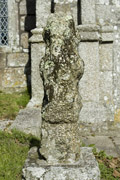
Object type: Part of cross-head and -shaft
Measurements: H. 80 cm (32 in); W. 44.5 cm (17.8 in) (head), 35 cm (14 in) (shaft); D. 22.5 cm (9 in) (head, max.), 19 cm (7.6 in) (shaft)
Stone type: Carnmenellis Granite, type 1c (A.V.B.)
Plate numbers in printed volume: Ills. 243-5
Corpus volume reference: Vol 11 p. 209-10
(There may be more views or larger images available for this item. Click on the thumbnail image to view.)
Broken cross-head with part of shaft. The cross-head has widely-splayed arms, linked by a ring which is slightly recessed from the face of the cross. The curved lower edge of the bottom cross-arm is indicated with an incised line. Due to the damage sustained by the head, it is not clear which type of either cross-head or ring were used. The three remaining holes are all circular and small and all of different diameters. The remaining part of the shaft contains no decoration at all. According to Langdon, the bottom of the shaft has a mortice 'five inches deep' (Langdon, Arthur 1896, 188); however this is unverifiable since the shaft is now fastened into a base.
A (broad): Although this face is very worn and mutilated, some decoration remains. In the centre and in the three remaining cross-limbs are large bosses set symmetrically, the centre boss measuring 13 cm (5.3 in) in diameter and protruding by 4.5 cm (1.8 in). There is an indication of a raised moulding linking the central boss to the boss in each arm. Around the head are traces of an incised edge-moulding.
B (narrow): Head mutilated; shaft undecorated
C (broad): As face A, but even more damaged and worn. The large central boss is complete but the bosses in the cross-arms are broken and there are no remains of any decoration.
D (narrow): As face B
This cross is unusual in featuring bosses on both sides of the head, the only other example being at Breage (Ills. 15–18). As Breage is only 6.5 km (four miles) away, this may be an indication of a very local group, although no other examples are known at present. It is regrettable that as both Wendron 1 and Breage 1 are so worn with only hints of further decoration, further comment is not possible. The suggestion of a raised moulding linking Wendron's bosses is also without parallel in Cornwall and the South-west, so although the presence of the bosses indicates a relationship with the Penwith group (Chapter IX, p. 89), both this and Breage should be distinguished from these monuments. The moulding linking the bosses may be compared with the 'spine-and-boss' or 'lorgnette' of the Cumbrian spiral-scroll school of carving, although these are rather different in practice (Bailey and Cramp 1988, 33–4, fig. 7).
The mortice in the base of the shaft is, as Langdon pointed out, unusual and if original indicates a very short shaft. However it is perhaps more likely that this mortice relates to a re-use of the cross at some stage.
Wendron church is associated with the Domesday royal manor of Helston, whose name containing the place-name element *hen-lys, 'ancient court' (Padel 1985, 130; Padel 1988, 96) indicates an early medieval administrative centre. Wendron church was also the mother church of a number of chapelries, so evidently a place of some status (Henderson, C. 1925, 217–18; Padel 2002, 309). Although recorded by the Cornish name of Eglosiga in 1208 (Padel 1988, 178), no place-name in *lann is known, and the dedication is to the otherwise unknown Cornish saint Wendron. This cross is therefore the earliest tangible evidence for the church site.
