Select a site alphabetically from the choices shown in the box below. Alternatively, browse sculptural examples using the Forward/Back buttons.
Chapters for this volume, along with copies of original in-text images, are available here.


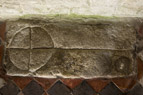
Object type: Grave-cover
Measurements: L. 129.5 cm (51 in); W. 48.3 > 45.7 cm (19 > 18 in); D. Unknown
Stone type: Carnmenellis Granite, type 1c (A.V.B.)
Plate numbers in printed volume: Ill. 327
Corpus volume reference: Vol 11 p. 247
(There may be more views or larger images available for this item. Click on the thumbnail image to view.)
Tapering cross-slab, set into the ground so that only face A is visible. The slab is probably complete.
A (broad): An incised cross extends from near the top of the slab to near the bottom. The cross-head consists of an incised latin cross enclosed by a compass-drawn circle. The vertical arm of the cross extends to form the shaft.
Appendix D item (continuing tradition)
This slab was considered by Langdon to be a 'very rare' example in Cornwall of an early cross-slab, and in marked contrast with the floriated cross-slabs of the thirteenth and fourteenth centuries (Langdon, Arthur 1896, 419). Thomas likewise thought that this and Lanivet 4 (Ill. 306) are 'of early type but not necessarily all that much pre-Norman — the Wendron one seems the earlier (8th–9th century?)' (Thomas, A. C. 1966b, 87).
In Wales, incised crosses of this form would normally be considered to belong to a class of cross-carved stones assigned a seventh- to ninth-century date, similar examples being at Trallwng in Breconshire and Margam in Glamorganshire (Redknap and Lewis 2007, 242–5, 452–5). On the other hand, a stone at Belstone in Devon with a similar incised cross on it has been dated widely, from the fourth to the twelfth century: a full discussion gives reasons for this conclusion (Cramp 2006, 90–1).
However, the Wendron 2 slab is considered to be a post-Norman Conquest feature. The most important reason for this is that there is a strong tradition of incised work on post-Norman Conquest wayside crosses in this area. Similar cross-forms can be seen on wayside crosses from Manhay Vean and Trenethick in Wendron, or Trewardreva in nearby Constantine parish (Langdon, Arthur 1896, 250–1, 285–6, 281–3): all are monuments of probable twelfth- to thirteenth-century date. Moreover the tapering shape of this slab allies it to typical medieval cross-slab grave-covers. Although cross-slab grave-covers are few in Cornwall, they can be divided into those which follow national trends, may be imported from Purbeck and have a foliated cross, and others carved from local materials, generally of simpler and more rustic design. This slab may be one of the latter, the form of its cross simply copying the local tradition seen on the wayside crosses.
