Select a site alphabetically from the choices shown in the box below. Alternatively, browse sculptural examples using the Forward/Back buttons.
Chapters for this volume, along with copies of original in-text images, are available here.


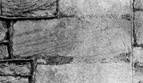
Object type: Decorated fragment
Measurements: L. 59 cm (23.2 in); W. 21 cm (8.25 in); D. > 23 cm (> 9 in)
Stone type: Limestone, yellow-brown, medium to coarse grained, ooidal and bioclastic. Middle Jurassic, Bajocian, Upper Lincolnshire Limestone Formation, Ancaster Stone. Identical to Costock 1 but cross-bedded
Plate numbers in printed volume: Ills. 14-5, 18-9
Corpus volume reference: Vol 12 p. 105
(There may be more views or larger images available for this item. Click on the thumbnail image to view.)
Costock 2 might represent a section from a substantial broad and narrow shaft. The south-facing visible surface is cut smooth and subsequently heavily weathered (Ill. 18); but, if this were a fragment from a shaft, this face would represent a section through the monument (face E or F) and may have only been generated during the stone's reuse in this quoin.
The second visible face (B — narrow), by contrast, is defined by two broad angle-fillets of rectangular section. Within the longitudinal panel thus defined there are clear traces of carved strands in low relief (Ill. 19). Despite our best efforts, however, the pattern of the decoration has eluded us. It might represent a complex interlace, as was perhaps observed in 1892 ((—) 1892b; see Ill. 14), though any such pattern is difficult to resolve. Alternatively, it is possible that we are seeing the final remains of a row of simple upright leaves.
The shape of the stone, and the location of the worked angles on face B, imply that this might be a section from a large example of the type of broad, thin shaft seen (for example) not that far away (25 miles east-south-east) at Stainby in Lincolnshire. The Stainby shaft, however, is a member of the large group which we christened the South Kesteven shafts, which were produced in quarries in southern Lincolnshire during the early and mid eleventh century (Everson and Stocker 1999, 29–33, 252). Costock 2 does not belong to this shaft group petrologically, but if it is correctly interpreted as a shaft at all, then it might represent a shaft of similar type (and perhaps date), produced in a different quarry centre.
The occurrence of Costock 2 in the same quoin as Costock 1 also requires comment. Its location might offer evidence that the quoin was re-built during the nineteenth-century restorations, because such analysis as we have been able to undertake does not suggest that Costock 2 represents a particularly early monument. In its turn this would imply that the stone is unlikely to have been available for reuse in the eleventh century (when, in assessing Costock 1, we propose the quoin was first built), and therefore that the quoin is re-built. The interpretation of this stone is extremely uncertain, however, and a date for its original production sufficiently early to permit its reuse in the eleventh century should probably not be ruled out.
