Select a site alphabetically from the choices shown in the box below. Alternatively, browse sculptural examples using the Forward/Back buttons.
Chapters for this volume, along with copies of original in-text images, are available here.


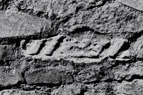
Object type: Decorated fragment, perhaps part of grave-cover
Measurements: L. 42 cm (16.5 in); W. 10 cm (3.9 in); D. Built in
Stone type: Lincolnshire Limestone, yellow-brown, coarsely ooidal and slightly shelly. Middle Jurassic, Bajocian, Upper Lincolnshire Limestone formation
Plate numbers in printed volume: Ill. 152
Corpus volume reference: Vol 12 p. 202-3
(There may be more views or larger images available for this item. Click on the thumbnail image to view.)
Certainty about what this stone represents is not possible. It is clearly a fragment from a much larger decorated stone, possibly a grave-cover, which originally had a raised moulding along one edge, defining the decoration. This moulding might have been of sub-circular section. Within the angle moulding the surface was evidently decorated with sculpture in low relief, of which only slight fragments survive. The decoration consisted of raised fillets of rectangular section, set at an angle to the border moulding. They are very straight for interlace components, and they are not linked inside the border moulding.
Appendix A item (stones dating from Saxo-Norman overlap period or of uncertain date)
We have been unable to make a clear case for the type of monument represented by this fragment of sculpture. The stone is obviously from a medieval monument, whilst the stone type might suggest that it is of early date. It might have come from one angle of a shaft or a cover. The pronounced diagonal fillets might possibly represent the decoration on the side of a shaft, such as that at Harmston 1 (Lincolnshire), where, however, the diagonal fillets form a zig-zag (Everson and Stocker 1999, 176–7, ills. 196, 198), which does not appear to be the case here. Chevrons, however, were used to decorate the cross itself on the late tenth- or early eleventh-century grave-marker at Glentworth 1 in the same county (ibid., 169, ill. 179).
