Select a site alphabetically from the choices shown in the box below. Alternatively, browse sculptural examples using the Forward/Back buttons.
Chapters for this volume, along with copies of original in-text images, are available here.


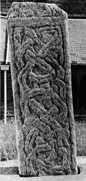
Object type: Part of cross-shaft and -head
Measurements: H. 85 cm (33.5 in); W. 35 > 33.5 cm (13.75 > 13.25 in); D. 12.5 > 12 cm (5 > 4.75 in)
Stone type: Medium-grained yellow sandstone
Plate numbers in printed volume: 543 - 5, 550
Corpus volume reference: Vol 2 p. 145
(There may be more views or larger images available for this item. Click on the thumbnail image to view.)
Slab-like shaft; head type not known. The broad faces of the head, and all sides of the shaft are bordered laterally by a roll moulding; on the lower part of face C there is an inner border moulding. Between the panels on the head and shaft on faces A and C is a flat-band border. The carving on all faces is in very shallow relief.
A (broad): Interlace decoration of unidentifiable type, with median-incised strands, remains on the vestigial head. On the single shaft panel below there is irregular interlace using stopped-plait interspersed with pellets. The upper register has included U-bend terminals and, in the lower right corner, one of the strands terminates in an animal's head with a thin ear, oval eye and (fanged?) open jaws.
B (narrow): The single panel on the shaft carries the worn remains of interlace, though only the median-incised lines now remain.
C (broad): On the head are the remains of interlace using stopped-plait. On the single shaft panel below are two linked but widely spaced knots: at the top is simple pattern E and at the bottom simple pattern F, which are linked by two diagonals forming a long glide, with triquetra ornament set within and around the loops. In the space between the two knots are the worn remains of two confronted animals whose lower parts dissolve into interlace; each has a single paw which crosses in the direction of its companion's jaws.
D (narrow): Interlace, type now unidentifiable.
Spiral-scroll school (Introduction, pp. 33–8). Unlike other examples of the school's work, the characteristic interlace strands are not here combined with spiral-scroll. The position and shape of the beast head on face A is closely paralleled locally on Beckermet St John 5. The confronted animals may be compared with the birds on Waberthwaite 2 and share with them a distinct Anglian ancestry (for a more coherent version of the composition, see Collingham, Yorkshire (Collingwood 1927a, fig. 31)).
