Select a site alphabetically from the choices shown in the box below. Alternatively, browse sculptural examples using the Forward/Back buttons.
Chapters for this volume, along with copies of original in-text images, are available here.


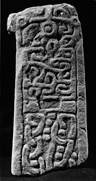
Object type: Part of cross-shaft and -head
Measurements: H. 71 cm (27.75 in); W. (head) 30 cm (11.75 in) (shaft) 32 > 27 cm (12.5 > 10.5 in); D. 18 > 16 cm (7 > 6.25 in)
Stone type: Medium-grained, micaceous yellow sandstone (St Bees sandstone, bleached)
Plate numbers in printed volume: 551 - 2, 554 - 5
Corpus volume reference: Vol 2 p. 145-146
(There may be more views or larger images available for this item. Click on the thumbnail image to view.)
Cross-head of either type A1 or A5 with a very short transverse arm; the upper arm may have had a broad curved arm-pit, type 9; slab-like shaft. All faces of the shaft and the surviving end of the cross-arm are bordered laterally by a grooved moulding; there is no panel division on the broad faces between the head and the upper part of the shaft.
A (broad): Cruciform head-pattern, type 2a (see Fig. 7), surrounded by spiral-scroll. The scroll, with pellets, extends into the upper part of the shaft below. Half way down the surviving shaft is a sub-rectangular depression cut into the flat-band moulding which divides the spiral-scroll ornament from the panel below. In this lower panel are two parallel rows of three-strand plain stopped-plait with pellets interspersed.
B (narrow): Three-strand plain stopped-plait with pellets.
C (broad): The broad curve of the upper arm-pit is visible on this face. The head and upper part of the shaft are decorated with spiral-scroll and pellets and this links below, round a partial horizontal border, into a stopped-plait pattern which can be interpreted either as two parallel rows of three-strand plain plait or as a single row of ring-chain; pellets are interspersed in the design.
D (narrow): On the end of the arm is an incised 'reversed spectacles' motif. On the shaft is an incised battlement pattern.
Spiral-scroll school (Introduction, pp. 33–8). If correctly interpreted as a Borre-derived ring-chain, the interlace motif on face C is a useful chronological indicator of the group's activities. The ornament on face B closely resembles that on the narrow faces of Unknown Provenance 1.
