Select a site alphabetically from the choices shown in the box below. Alternatively, browse sculptural examples using the Forward/Back buttons.
Chapters for this volume, along with copies of original in-text images, are available here.


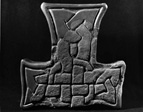
Object type: Part of cross-head
Measurements: H. 43.2 cm (17 in); W. 53.3 cm (21 in); D. 12.5 cm (5 in)
Stone type: Medium-grained red sandstone (St Bees sandstone?)
Plate numbers in printed volume: 556 - 9
Corpus volume reference: Vol 2 p. 147
(There may be more views or larger images available for this item. Click on the thumbnail image to view.)
Cross-head, type 10B, but with tall upper arm and right-angled arm-pits. The decoration on the two broad faces is bordered by a grooved moulding.
A (broad): The two surviving arms are filled by Stafford knots whose strands connect to the opposing (not adjacent) arms. A free ring surrounds the crossing. The strands are formed of broad rectangles 'stopped' against each other at crossing points; there is a pellet between knot and circle in the upper arm.
B (narrow): Undecorated.
C (broad): A central boss in low relief is surrounded in the restoration by a Stafford knot in the upper arm and a four strand plain plait in the horizontal arms, all formed by strands similar to those on face A.
The free-armed head with tall upper member is in an Anglian tradition (e.g. Collingwood 1927a, fig. 63) and the use of Stafford knots in the arms also has a long history in Insular sculpture. The square arm-pits and the broad flat units of the interlace strands, however, are characteristic of Viking-period carving (see Kirkby Stephen 1 and Muncaster 1).
The use of strands connecting opposing arms of the cross is rare in England, Wales and Scotland but it is ubiquitous amongst Viking-age carvings on Man where it is frequently associated, as here, with a ringed crossing (Ill. 681). Outside Man only Barochan, Renfrewshire, where there is a double ring, has an encircled crossing of this kind (Allen 1903, fig. 475), and like Stanwix should probably be seen as a reflex of a Manx fashion.
