Select a site alphabetically from the choices shown in the box below. Alternatively, browse sculptural examples using the Forward/Back buttons.
Chapters for this volume, along with copies of original in-text images, are available here.


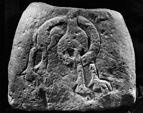
Object type: Cross-base
Measurements:
H. 53 cm (21 in); W. 68.5 > 51 cm (27 > 20 in); D. 51 > 40.5 cm (20 > 16 in)
Socket: 31.5 x 24.5 x 21 cm (12.4 x 9.6 x 8 in)
Stone type: Medium-grained red sandstone (St Bees sandstone)
Plate numbers in printed volume: Ills. 668-71
Corpus volume reference: Vol 2 p. 171
(There may be more views or larger images available for this item. Click on the thumbnail image to view.)
A (broad): This face is very worn, especially at the edges, and no traces of a moulding survives. The field is entirely filled with a quadruped. Its feet are large, three toed, and spurred like a bird's. lts body is extended into a reptilian form which curls through its front legs and behind its long back, then swells slightly as it joins the back legs. Its tail is curled through its back legs and under its body. There is the trace of what may be a down-bent head on the top right comer.
B (narrow): The carving on this side is almost worn away although there is an incised frame at the base. A human figure, seemingly a man wearing a short tunic, stands in front of a quadruped whose head is bent back. The man appears to be touching and leaning away from the quadruped. It is difficult to determine the nature of the beast but its legs are long and hooved like a horse's.
C (broad): This face survives in deep relief with broad rolled edge mouldings. A seated figure is shown with feet cutting the mouldings. They are widely spread and shackled by a single band with loops round each ankle. The figure is possibly seated with its back to the observer. Its knees are raised and under them coiled two serpents whose heads appear by its shoulders.
Collingwood placed this socket in the twelfth century, although he recognized that the fabulous creatures depicted on it had an obvious pre-Conquest ancestry and specifically related them to Icelandic legends (Collingwood 1903a, 383-4). Nevertheless he saw some resemblance between the bound man - a Loki-type - with the classical Laocoön. The use of exotic animals to illustrate allegorically spiritual truths, or secular moral fables, is not confined to the twelfth century. Bestiary tales exist in late Saxon forms, and - perhaps of some relevance to this region – Pictish and Picto-Scottish art has produced a rich menagerie of such beasts (Henderson 1982, 90-7). The body coiled from the hip as shown on the animal in face A is a very distinctive characteristic of Pictish beasts. It is a feature found in sculpture as early as Aberlemno (Allen 1903, fig. 227a) and is found in a form comparable to the Cumbrian beast in Meigle 9 and Meigle 11 (Allen 1903, figs. 343b, 345a-b). Another characteristic feature of Picto-Scottish animals is the manner in which the tails curl between their legs (Allen 1903 fig. 313a). Sinuous creatures such as that on face D are also found at Kettins (Allen 1903, fig. 236) and such fabulous beasts seem to be popular in the North from the ninth to eleventh centuries. It is possible that on this piece one sees reflected influences from north of Solway such as are also demonstrated by the 'stopped-plait' (Introduction, p. 36). The bound creature can be compared with the bound figures on the Gosforth cross (no. 1), or with the exotic 'mermaid' type figures on the Lowther hogbacks (nos. 4-5).
