Select a site alphabetically from the choices shown in the box below. Alternatively, browse sculptural examples using the Forward/Back buttons.
Chapters for this volume, along with copies of original in-text images, are available here.


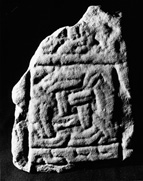
Object type: Part of cross-shaft and -head
Measurements: H. 37.5 cm (14.75 in); W. 28 > 23 cm (11 > 9 in); D. 8 > 6 cm (3.25 > 2.5 in)
Stone type: Medium-grained red sandstone (St Bees sandstone)
Plate numbers in printed volume: 560 - 3
Corpus volume reference: Vol 2 p. 150-151
(There may be more views or larger images available for this item. Click on the thumbnail image to view.)
Rectangular cross-shaft with cross-head, possibly type 11 with ring, type (a)/(b).
A (broad): Three panels survive, bordered laterally by a roll moulding. At the top above a plain border there are traces of interlace on what remains of the head; the strands seem to carry a median-incised line. Below is a ring-knot (with one free ring) formed by strands with a median-incised line; these have a stopped-plait appearance. At the bottom of the fragment is a horizontal band of step pattern 1 (G.I., fig. 27).
B (narrow): At the top of this side is the springing for the ring of the cross-arm. On the panel below is interlace of unidentifiable type using median-incised strands, flanked by a roll moulded border.
Collingwood restored the interlace on face B as a run of Stafford knots, which would allow this piece to be grouped with the Beckermet school (Introduction, pp. 38–40). Though possible, this restoration is far from convincing and, indeed, the treatment of the interlace is closer to that of the spiral-scroll school (Introduction, pp. 33–8).
