Select a site alphabetically from the choices shown in the box below. Alternatively, browse sculptural examples using the Forward/Back buttons.
Chapters for this volume, along with copies of original in-text images, are available here.


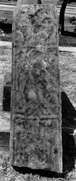
Object type: Part of cross-shaft
Measurements: H. 110 cm (43.25 in); W. 32 > 29.75 cm (12.5 > 11.75 in); D. 18 > 16 cm (7 > 6.25 in)
Stone type: Medium-grained red sandstone (St Bees sandstone)
Plate numbers in printed volume: 571 - 2, 577 - 8
Corpus volume reference: Vol 2 p. 151
(There may be more views or larger images available for this item. Click on the thumbnail image to view.)
The broad faces have been severely damaged by reuse, but all the surfaces are very eroded. The shaft seems to have been edged by a roll moulding.
A (broad): Traces of three panels marked out by roll mouldings. It is impossible to decipher the ornament that they enclosed.
B (narrow): A plant trail in which each curve is filled by a long stemmed leaf of a plain triangular type. Near to the top of the shaft the composition has gone wrong and the carver has inserted an additional leaf.
C (broad): The surface is nearly completely obliterated. There may be traces of a double roll moulding at the edges possibly enclosing a spiral scroll.
D (narrow): A changing interlace pattern separated by glides of varying length: at the top, probably half pattern C; then a single spiralled pattern A knot; and below a form of below, one register of complete turned pattern D with U-bend terminals, and what is probably part of a second, turned the opposite way up to the first.
The changing patterns of interlace which are departing from precise geometric principles, and the berryless trail are all late features in the pre-Viking period. Despite the difference in technique this piece need not be very far removed in time from no. 2. Stylistically it is most like crosses in Yorkshire such as Hauxwell (Collingwood 1907a, 331, figs. a–d), or Collingham (Collingwood 1915a, 158, fig. e).
