Select a site alphabetically from the choices shown in the box below. Alternatively, browse sculptural examples using the Forward/Back buttons.
Chapters for this volume, along with copies of original in-text images, are available here.


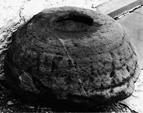
Object type: Cross-socket(?) [1]
Measurements:
H. 25.5 cm (10 in); Diameter 56 > 43.25 cm (22 > 17 in)
Socket: 19 x 11 cm (7.5 in x 4.25 in)
Stone type: Coarse-grained red sandstone (Penrith sandstone)
Plate numbers in printed volume: 654–5
Corpus volume reference: Vol 2 p. 169
(There may be more views or larger images available for this item. Click on the thumbnail image to view.)
This solid block of stone is of a dome-like shape surrounded by three roughly incised lines framing vertical incisions which give it the appearance of cable moulding. The surface around the socket hole is flattened and the hole is neatly cut.
Appendix A item (stones dating from Saxo-Norman overlap period or of uncertain date).
It is perhaps an aberration on the part of this author to consider this as pre-Conquest in date and as the socket for a pole-like cross. Nevertheless its peculiar shape – rather like a solid beehive quern – does not readily suggest any other use. From the same field the farmer also ploughed up another stone with a socket-hole 8.5 in in diameter and 3.75 in in depth, but this was a flat, featureless stone and has not been included here. The placing of a wooden cross in a mill-stone is recorded in Adomnan's Life of St Columba, as are other wooden crosses. (Adomnan 1961, 21, 115, 306–7, 522–3), and at Iona the development from wooden to stone monuments can be charted (discussed in R.C.A.H.M. 1982, 17–19). Cumbria, where so few pre-Conquest stone churches have survived, has links north across the Solway throughout that period. It would have been strange if no wooden crosses were known from the region, and one wonders how they would be recognized in the archaeological record.
