Select a site alphabetically from the choices shown in the box below. Alternatively, browse sculptural examples using the Forward/Back buttons.
Chapters for this volume, along with copies of original in-text images, are available here.


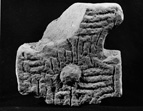
Object type: Part of cross-head
Measurements: H. 31.3 cm (12.25 in); W. 30.7 cm (12 in); D. 11.9 cm (4.5 in)
Stone type: Fine-grained red sandstone (St Bees sandstone)
Plate numbers in printed volume: 573 - 6
Corpus volume reference: Vol 2 p. 153
(There may be more views or larger images available for this item. Click on the thumbnail image to view.)
Cross-head, type E10, but with curved arm-pits to upper arm. The ornament on the two broad faces is bounded by a roll moulding.
A (broad): At the centre of the cross-head is a boss in high relief. This is surrounded by pseudo-interlace formed, in the main, by continuous parallel strands which follow the outline of the cross-head.
B and D (narrow): An unframed incised linear St Andrew's cross.
C (broad): A flat boss, in low relief, is surrounded by pseudo-interlace formed by continuous parallel cords which follow the outline of the cross-head.
The hammerhead shape of this cross is a type whose main concentration lies in the north-west (Introduction, p. 31). Its interlace, which makes no attempt to suggest the crossings of conventional plaitwork, can be compared to examples discussed under Burton in Kendal 3 and Millom 2, which all reflect a new, less ambitious, impressionistic approach to a conventional form of ornament. The incised St Andrew's cross recurs in Yorkshire at Finghall and Wath in association with other pseudo-interlace (Collingwood 1907a, 320, 407), though this simple form of decoration goes back to the Anglian period (Collingwood 1907a, 373).
