Select a site alphabetically from the choices shown in the box below. Alternatively, browse sculptural examples using the Forward/Back buttons.
Chapters for this volume, along with copies of original in-text images, are available here.


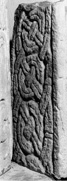
Object type: Part of cross-shaft [1]
Measurements: H. 42 cm (16.5 in); W. 23 > 22 cm (9 > 8.75 in); D. 14 > 12 cm (5.5 > 4.75 in)
Stone type: Medium-grained yellow sandstone (Carboniferous)
Plate numbers in printed volume: 593 - 6
Corpus volume reference: Vol 2 p. 156
(There may be more views or larger images available for this item. Click on the thumbnail image to view.)
Rectangular cross-shaft. The single incomplete panels on all four faces are bordered laterally by a flat-band moulding.
A (broad): Interlace consisting of free rings with long diagonals and outside strands. The strands are median-incised and the two halves are bound together when operating as outside strands.
B (narrow): Free rings and long diagonals, using median-incised strands.
C (broad): Interlace, a form of half pattern F with outside strand, using double-incised strands. The three sections so formed are bound together by a single strand 'tie' in the upper right-hand corner.
D (narrow): A run of Stafford knots, two complete and parts of two others.
Beckermet school (Introduction, pp. 38–40). The use of double-incised strands is found elsewhere in the school on Beckermet St John 4, Brigham 2 and Haile 2, whilst the binding motif is repeated on Beckermet St John 4, 6 and 7, and again on Haile 2. The pattern on face A is also used on Beckermet St John 6 and Haile 2, whilst the interlace on face C is a variant of the form seen on Beckermet St John 3–6; both interlace motifs are limited to the Beckermet school.
