Select a site alphabetically from the choices shown in the box below. Alternatively, browse sculptural examples using the Forward/Back buttons.
Chapters for this volume, along with copies of original in-text images, are available here.


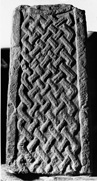
Object type: Part of cross-shaft and -head [1]
Measurements: H. 46 cm (18 in); W. 23.5 > 21 cm (9.25 > 8.25 in); D. 15 > 13 cm (6 > 5 in)
Stone type: Medium-grained grey sandstone (Carboniferous)
Plate numbers in printed volume: 589 - 92
Corpus volume reference: Vol 2 p. 155-156
(There may be more views or larger images available for this item. Click on the thumbnail image to view.)
Rectangular cross-shaft; remains of cross-head, probably circle type 3. All four faces of the shaft carry incomplete single panels bordered by a flat-band moulding.
A (broad): Angular eight-strand plain plait with median-incised strands extends below the curved flat-band border marking the bottom of the cross-head.
B (narrow): At the top an angular six-strand plain plait terminates in loose curled strands. Below is the rear end of a ribbon animal whose body is decorated with pellets and billets contained within a contour moulding. Three pointed and hollowed extensions are placed at the outer curves of the body, the contour moulding striking a contrary curve to accommodate them. A semi-circular indentation interrupts the beast's outline on one of its curves. The animal terminates at the top of the panel in two hollow-centred tendrils connected to a split-leaf.
C (broad): Angular six-strand plain plait with median-incised strands.
D (narrow): At the top is an angular triquetra whose strands carry a median incised line; this terminates in a pointed lobed foliate motif. Below, the rest of the visible panel is occupied by the rear ends of two interlocked ribbon animals with contoured bodies. Each has two legs and a foliate tail of split-leaf type with curling contoured tip. The shorter leg is placed between the border moulding and the crossing bodies; it has two toes and its joint breaks into the contour line of the body. The second leg, also two-toed, stretches upward against the border moulding; the foliate tails, which spring from the contour line of the animals, loops around this second leg.
This circle-headed cross carries a kind of animal ornament which is rare among Northumbrian sculptures. Though contoured outlines, semi-circular indentations and general interlocked disposition, are familiar features of the Jellinge style, the foliate and tendril motifs associated with all of the beasts, and the heavy body marking of the animal on face B, are more typical of Mammen work. This is a phase of art which is better evidenced on the Isle of Man than in English sculpture.
