Select a site alphabetically from the choices shown in the box below. Alternatively, browse sculptural examples using the Forward/Back buttons.
Chapters for this volume, along with copies of original in-text images, are available here.


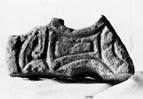
Object type: Part of cross-head [1]
Measurements: (after Mason and Valentine 1928) H. 17.5 cm (7 in); W. 8.9 cm (3.5 in); D. 5.1 cm (2 in)
Stone type: Unobtainable
Plate numbers in printed volume: 598
Corpus volume reference: Vol 2 p. 156-157
(There may be more views or larger images available for this item. Click on the thumbnail image to view.)
A (broad): The published photograph shows a cross-arm with curved arm-pits. The arm-pits are bordered by roll mouldings and between them is a sub-rectangular undecorated panel surrounded on all four sides by flat-band framing. To the right are the remains of (probably) an encircled boss at the centre of the head. To the left is a curved panel containing interlace using strands with median-incised line.
The curved panel to the left suggests that the fragment came from the circle of a circle-headed cross with characteristic Cumbrian plait decoration (Introduction, pp. 31–2).
