Select a site alphabetically from the choices shown in the box below. Alternatively, browse sculptural examples using the Forward/Back buttons.
Chapters for this volume, along with copies of original in-text images, are available here.


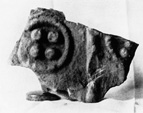
Object type: Part of cross-head [1]
Measurements: (after Mason and Valentine 1928) H. 14 cm (5.5 in); W. 21.5 cm (8.5 in)
Stone type: Unobtainable
Plate numbers in printed volume: 599
Corpus volume reference: Vol 2 p. 157
(There may be more views or larger images available for this item. Click on the thumbnail image to view.)
A (broad): This is the only face that is illustrated. In the centre is a ring in high relief enclosing four (perhaps originally five) pellets. The ground around the centre is open and smoothly dressed, and there is on the right a heavy vertical moulding which seems to mark off the cross-arm. Traces of what seem to be a plant strand and berries on the right are broken away so that it is impossible to guess their layout.
This fragment is most plausibly seen as part of a cross-head although Mason and Valentine (1928) suggested that it could possibly have been a headstone. Cross-heads with four or five bosses enclosed in the centre of the head are a relatively common type in the north-west, as I have discussed in relation to Irton 1.
