Select a site alphabetically from the choices shown in the box below. Alternatively, browse sculptural examples using the Forward/Back buttons.
Chapters for this volume, along with copies of original in-text images, are available here.


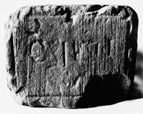
Object type: Architectural fragment [1]
Measurements: (after Mason and Valentine 1928) H. 12.5 cm (5 in); W. 15 cm (6 in); D. 36.5 cm (14.5 in)
Stone type: (after Mason and Valentine 1928, 59) 'red sandstone'
Plate numbers in printed volume: 600 - 1
Corpus volume reference: Vol 2 p. 157
(There may be more views or larger images available for this item. Click on the thumbnail image to view.)
The stone was described as 'cigar shaped' at one end and merging into four flat sides (Mason and Valentine 1928, 59).
A: Outlined by a single roll moulding which had been marked out with a fine punch. There is a crescent-shaped mark in the upper left corner, and an inscription in Anglo-Saxon capitals centrally placed on the face. This reads:
OSI[..I]D
Mason and Valentine considered that this piece might have been a headstone which could have been driven into the ground using the tapered end. In view of the stone discovered in excavations in 1973 at Jarrow monastic site (Cramp 1984, 114, pl. 97, 522) which had clearly been built into a wall it seems more reasonable to see this as also designed to be built into a structure. Like the Jarrow stone it bears a single personal name, although whether male or female is impossible to determine. Mason and Valentine (1928, 60) reconstructed the inscription as OSITHGID but Okasha is more circumspect. I have followed her reading (Okasha 1971, 129).
