Select a site alphabetically from the choices shown in the box below. Alternatively, browse sculptural examples using the Forward/Back buttons.
Chapters for this volume, along with copies of original in-text images, are available here.


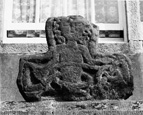
Object type: Part of cross-head
Measurements: H. 46 cm (18 in); W. 58 cm (22.8 in); D. 17 cm (6.7 in)
Stone type: Medium-grained red sandstone (St Bees sandstone)
Plate numbers in printed volume: 144 - 7
Corpus volume reference: Vol 2 p. 76-77
(There may be more views or larger images available for this item. Click on the thumbnail image to view.)
Cross-head, type B10. The decoration on faces A and C, and on the ends of the arms on B and D, is framed by a roll moulding.
A (broad): A curly-haired naked figure grasps, with his right hand, the irregular interlace (snake?) bound across his stomach. His left hand, with open palm, lies above the interlace in the right arm of the cross.
B (narrow): Two simple pattern E knots, placed back to back.
C (broad): At the centre of the head is a circle in high relief surrounding seven bosses. In the upper arm is a human mask, whilst the lateral arms are filled with delicate interlace. In the left horizontal arm are two registers of complete pattern A turned, with cross-joined terminal at the top; the loops of the lower register appear to be linked but the form of the terminal is now not clear. The interlace in the right arm was probably similar, but is now too worn for certain identification.
D (narrow): Worn interlace (a simple pattern E knot?).
Multiple pellets within rings occur in Northumbrian sculpture of both the Anglian and Viking periods but the short dumpy arms of this cross are typical of local taste in the tenth and eleventh centuries. This dating is supported by the shape of the panels in the lateral arms of face C, which belong to a group which Stevenson labelled as 'elephant-ear' (Stevenson 1958–9, 50). This group is restricted to the Solway area; Brigham 6 provides a second Cumbrian example whilst, to the north of the estuary, the type is found at Drummore, Wigtownshire, and on the Netherton cross, Hamilton, Lanarkshire (Collingwood 1927a, fig. 18; Stevenson 1958–9, pl. X).
The human mask set in the upper arm of face C can be interpreted as a symbolic Crucifixion, with Christ's head set over the cruciform shape of the cross (Bailey 1963a; idem 1980, 150–1). This iconography can be paralleled in Insular contexts in Ireland and at Kiloran (Colonsay, Argyllshire) in western Scotland (Roe 1960) though it must have been an archaic survival at the date of Brigham's carving. The figure on face A can be grouped with a variety of carvings in the north-west which depict men struggling with entangling snakes; the (clothed) figure from Great Clifton provides the best local parallel. This Brigham figure may represent Christ triumphant and thus complement the Crucifixion scene on the other face but, since there is no identifying halo, this must remain a speculation.
