Select a site alphabetically from the choices shown in the box below. Alternatively, browse sculptural examples using the Forward/Back buttons.
Chapters for this volume, along with copies of original in-text images, are available here.


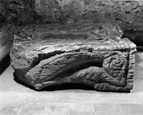
Object type: Cross-base, in two joining pieces
Measurements:
H. 34 cm (13.4 in); W. 90 cm (35.4 in); D. 75 cm (29.5 in)
Socket: 40 x 19 > 16 x 34 cm (15.75 x 7.5 > 6.3 x 13.4 in)
Stone type: Coarse-grained yellow sandstone (Carboniferous)
Plate numbers in printed volume: 168 - 71
Corpus volume reference: Vol 2 p. 77-78
(There may be more views or larger images available for this item. Click on the thumbnail image to view.)
The socket hole is surrounded by a roll moulding and the outer edge of the top is bordered by a cabled moulding. Apart from this upper cabled moulding the full-length panels on the side faces are otherwise framed by a plain roll moulding.
A: The entire panel is occupied by the contoured body of a crouching animal whose spiral hip and three-toed back leg are set in the right-hand part of the panel. There is a small curled tail in the upper right corner.
B: To the left is the contoured body of a sprawling animal whose lower parts dissolve into interlace consisting of a register of half pattern C with bar terminal, the strands being median-incised. The animal's bird-like head is seen in profile with a round eye set within a domed forehead. The three-toed paws flanking this head are attached to the body by contoured shoulders. The tail terminating the interlace curls under the body.
C: Interlace of changing six-cord patterns. The terminal is a pattern E unit with included terminal. This is linked to a half pattern C with added diagonal which, in turn, joins to a half pattern C with outside strands. Next follows a form of ring-knot(?) terminating, in the upper right corner, in a beast head with a single ear and long jaws, the lower of which is curled; beneath the eye is an incised spiral.
D: Recut.
E (top): Surrounding the socket hole three sides each carry one register of half pattern C, irregularly laid out, whilst the fourth side (above face B) is decorated with a register of pattern A(?) terminating in an animal's head whose jaws, similar to those on face C, bite onto the loose tail. The eye is strongly marked and there are traces of spiralling below it which suggest that the beast resembled the animal on face C in this detail also.
The animal ornament, with its use of contouring and spiral hips, is clearly influenced by Jellinge art. The basic disposition of the animals on faces A and B can, however, be traced back to pre-Viking Anglian art (see p. 26). The socket from Beckermet St John (no. 7) is similar in shape and this form may represent a local fashion.
