Select a site alphabetically from the choices shown in the box below. Alternatively, browse sculptural examples using the Forward/Back buttons.
Chapters for this volume, along with copies of original in-text images, are available here.


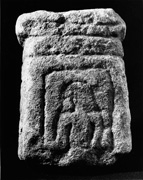
Object type: Part of cross-shaft and -head
Measurements: H. 33 cm (13 in); W. (shaft): 24 > 21 cm (9.5 > 8.25 in) (start of head): 24.5 cm (9.75 in); D. 12 cm (4.75 in)
Stone type: Coarse-grained yellow sandstone (Carboniferous)
Plate numbers in printed volume: 185 - 8
Corpus volume reference: Vol 2 p. 83
(There may be more views or larger images available for this item. Click on the thumbnail image to view.)
Upper part of rectangular cross-shaft with the lower part of the head surviving as a broad moulding on face A and as a moulded offset on faces B and D.
A (broad): An incised horizontal line across the broad moulding at the top of the fragment probably marks the lower border of the panel on the lost head and there are traces of the curve of the arm to the right. Below a second horizontal roll moulding, which continued round the whole head, is a figural scene, bordered above and laterally by yet another roll moulding. At the centre is a figure with hair or halo, standing beneath an arch; the right hand is bent at the elbow and passes in front of the arch.
B (narrow): Below the offset of the head is a roll moulding set over a panel of unidentifiable relief ornament bordered by a roll moulding.
C (broad): Cut away.
D (narrow): Below the offset of the head is a roll moulding set over a panel of incised St Andrew's crosses placed one above the other. Each triangle and diamond thus formed is decorated with a drilled hole. The panel was framed by a plain roll moulding.
By analogy with Yorkshire carvings at Burnsall and Kildwick (Collingwood 1915a, 149, 198) it is likely that this shaft originally had a free-armed head. The placing of figural ornament within an arched frame set within the panel borders is an ornamental feature favoured in the north-west of England during the Viking period (see p. 82). The ornament on face D is not found elsewhere in Cumbria but there are other examples spread over a wide area from Galloway to Yorkshire and Northumberland (Collingwood 1927a, figs. 11 and 226a; Collingwood 1915a, 149; Cramp 1984, pls. 234, 1330; 259, 1410).
