Select a site alphabetically from the choices shown in the box below. Alternatively, browse sculptural examples using the Forward/Back buttons.
Chapters for this volume, along with copies of original in-text images, are available here.


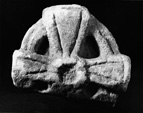
Object type: Part of cross-shaft and -head
Measurements: H. 32 cm (12.5 in); W. 36 cm (14.25 in); D. 16 cm (6.3 in)
Stone type: Coarse-grained yellow sandstone (Carboniferous)
Plate numbers in printed volume: 193 - 5, 197
Corpus volume reference: Vol 2 p. 83-84
(There may be more views or larger images available for this item. Click on the thumbnail image to view.)
Cross-head, type 6B, with a ring of type 1a; this ring has an additional narrow outer ring. The arm-pits are not completely pierced.
A (broad): At the centre of the cross arm is a circle in high relief. A grooved moulding borders the arms and meets the circle, but there is no other decoration.
B and D (narrow): No ornament or border moulding survives.
C (broad): A grooved moulding borders all surviving arms.
The double ring recurs locally on a ring-head, Kirkby Stephen 7, and at Muncaster on the circle head from Irton parish (no. 2); it is also a distinctive local fashion in tenth-century Ryedale (Bailey 1980, 183–4). Though wedge-shaped arms have been claimed by Collingwood (1927a, 142) as a late pre-Norman feature, the use of this form at Gosforth (no. 2) on a cross with close stylistic links to the tenth-century shaft (no. 1), argues that this Burton in Kendal head could also belong to the early Viking period.
