Select a site alphabetically from the choices shown in the box below. Alternatively, browse sculptural examples using the Forward/Back buttons.
Chapters for this volume, along with copies of original in-text images, are available here.


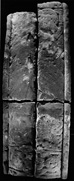
Object type: Grave-cover or sarcophagus lid(?), in four joining pieces
Measurements: L. 186 cm (73.2 in); W. 72.5 > 69.5 cm (28.5 > 27.4 in); D. 12 cm (4.7 in)
Stone type: Medium-grained red sandstone (St Bees sandstone)
Plate numbers in printed volume: 340 - 4
Corpus volume reference: Vol 2 p. 112
(There may be more views or larger images available for this item. Click on the thumbnail image to view.)
The four fragments form near-adjacent parts of a grave-cover or sarcophagus lid. The long sides are bowed and the top is slightly ridged. A roll moulding in high relief separates the top from the long sides; another moulding, in somewhat shallower relief, borders the decoration at the short ends of the top.
A (top): The worn decoration is divided into at least two panels. One, running across the stone at one end, is clearly bounded by a flat-band border and contains interlace consisting of free rings and long diagonals with outside strands. The strands are double-incised. It is possible that there were as many as four further panel divisions on the rest of the stone, since differing forms of interlace are still visible. At the opposite end to the small panel just discussed there are traces of interlace running lengthways down the stone, consisting of free rings and long diagonals with outside strands. The strands are double-incised and there is a binding laid across a strand in one corner of the panel. Closely adjacent to the panel first described more interlace is visible and seems to involve a closely packed and more elaborate pattern than occurs elsewhere on the slab.
B (long): The upper panel border bows towards the middle of the stone. Decoration consists of registers of simple pattern E using double-incised strands. At one end this terminates in a zoomorphic head. The head is round and cabled on the top, its central drilled eye surrounded by a circle. One long upper jaw is visible.
C (end): Cut away.
D (long): The panel shape and decoration are as side B though the only termination of the interlace to survive is a tightly curled spiral; the strands are median-incised.
E (end): Cut away.
Beckermet school (Introduction, pp. 38–40), using the runs of simple pattern E knots characteristic of the school as well as employing double-incised strands of the type recurring elsewhere in the group on Beckermet St John 4, Brigham 2 and Workington 4. The interlace type in the small panel is also found on Beckermet St John 6 and Workington 4, and is clearly another of the school's patterns. A further marker of the school is the use of a binding laid across the interlace strand (see Beckermet St John 4, 6–7 and Workington 4). The zoomorphic terminal with large round eye, long jaw and cabled head is so closely matched on Beckermet St John 4 and 6 that it is difficult to believe that the three sculptures are not from the same hand.
The shape of this stone cannot be closely paralleled. In its bombé ground plan the closest analogue is provided by a slab from Levisham, Yorkshire (Bailey 1980, pl. 17), though such plans are also characteristic of hogbacks where it is usually assumed that the form echoes that of contemporary Viking-period houses. The Levisham slab has a flat top but the curving ridge of the Haile stone can be paralleled on slabs from Stonegrave, Yorkshire and All Saints Pavement, York (Firby and Lang 1981, 20). All of these parallels are from the Viking period.
