Select a site alphabetically from the choices shown in the box below. Alternatively, browse sculptural examples using the Forward/Back buttons.
Chapters for this volume, along with copies of original in-text images, are available here.


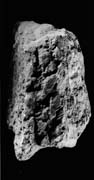
Object type: Fragment of cross-shaft [1]
Measurements: H. 24.3 cm (9.6 in); W. 24.5 cm (9.7 in); D. 13.2 cm (5.2 in)
Stone type: Fine-grained, calcareous, yellow (10YR 8/6) sandstone; Middle Calcareous Grit, Coralline Oolite Formation, Middle Oxfordian, Upper Jurassic?; perhaps from Sinnington/Middleton or Malton/Stonegrave areas.
Plate numbers in printed volume: 777-780
Corpus volume reference: Vol 3 p. 204-205
(There may be more views or larger images available for this item. Click on the thumbnail image to view.)
The shaft has a very damaged plain edge moulding.
A (broad): There is a fragment of open interlace with very broad median-incised strands. At its intersection there may have been a small pellet or frond. The traces are too fragmentary to determine the pattern.
B (narrow): Apart from a narrow edge moulding, the side is badly damaged. There are traces of what may hae been a step pattern.
C (broad): At the base is part of a median-incised free ring. From its outer edge a fan of median-incised, petal-like elements spreads upwards.
D (narrow): Within narrow edge mouldings are the worn remains of an interlace using median-incised strands: apparently a free ring crossed by long diagonals.
There are no parallels for the ring and fan motif, unless it is a formalized version of the bound bird found in the Weland iconography which is present at the site: see no. 3. The binding by a ring, together with the upward pointing bird head of no. 3, should be compared with the device on a silver penny of Anlaf II Guthfrithsson, struck by the York moneyer Æthelferth c. 940 (Dolley 1965, 25, pl. IX, no. 32).
