Select a site alphabetically from the choices shown in the box below. Alternatively, browse sculptural examples using the Forward/Back buttons.
Chapters for this volume, along with copies of original in-text images, are available here.


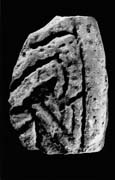
Object type: Part of cross-arm [1]
Measurements: H. 25.5 cm (10 in); W. 17.5 cm (7 in); D. 17.8 cm (7 in)
Stone type: Fine-grained, micaceous, very pale brown (10YR 8/3) sandstone; see no. 1.
Plate numbers in printed volume: 781-784
Corpus volume reference: Vol 3 p. 205
(There may be more views or larger images available for this item. Click on the thumbnail image to view.)
The end of an arm, probably from a type E11 free-armed cross.
A (broad): The perimeter moulding is flat. Within, broad, median-incised strands form a the terminals of an interlace pattern.
B (narrow): Worn and damaged.
C (broad): This face is extremely worn but has traces of broad, median-incised strands, forming the terminals of an interlace.
D (narrow): Broken away.
E (top): The convex surface is damaged and pock-marked.
Collingwood reconstructed the cross-head as an example of his penannular type (1911a, 271). Similar crosses are found in Elmet (e.g. at Aberford, West Riding (idem 1915, figs. a–f on 130)). The Sherburn piece does not share their exaggerated form and is a far cry from the Whithorn stones with which Collingwood compares it.
