Select a site alphabetically from the choices shown in the box below. Alternatively, browse sculptural examples using the Forward/Back buttons.
Chapters for this volume, along with copies of original in-text images, are available here.


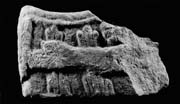
Object type: Part of cross-arm [1]
Measurements: H. (max.) 18.9 cm (7.4 in); W. 30 cm (11.8 in); D. 14.8 cm (5.9 in)
Stone type: Medium-grained, slightly micaceous, brownish-yellow (10YR 8/2) sandstone; see no. 1.
Plate numbers in printed volume: 785-790
Corpus volume reference: Vol 3 p. 205-206
(There may be more views or larger images available for this item. Click on the thumbnail image to view.)
The piece is part of a lateral arm of a free-armed cross of type E10.
A (broad): There is a continuous median-incised edge moulding, lightly modelled, though much worn. Within the panel is Christ's right arm, extended stiffly and straight; the fingers and thumb are laid together with the palm open. Above and below the arm are two upper bunches of leaves, rather like acanthus fans but more stiff; the two upper bunches each have three leaves with median incisions, the two lower having four or five of the same character with rounded tips. Above the shoulder is a broken feature which may have been another foliate motif.
B (narrow): Broken away.
C (broad): Recut.
D (narrow) and E (top): Plain.
F (bottom): Roughly dressed.
The relief of the carving is not as modelled as Collingwood implied, though part of the chest drawn by him has flaked off. The position of Christ on the cross-head is typical of late monuments. The naked body is also found on the Crucifix from St Mary Castlegate, York, (no. 2; Ill. 297); but the customary Ryedale version is clothed and not as accomplished. The acanthus sprays are extremely rare in northern England, and suggest connections with Reform-period carvings in the south.
