Select a site alphabetically from the choices shown in the box below. Alternatively, browse sculptural examples using the Forward/Back buttons.
Chapters for this volume, along with copies of original in-text images, are available here.


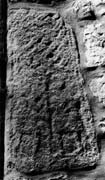
Object type: Part of cross-shaft [1]
Measurements: H. 70.5 cm (27.75 in); W. 30.5 cm (12 in); D. Built in
Stone type: Coarse-grained, very pale brown (10YR 7/3) sandstone; deltaic channel sandstone, Saltwick Formation, Aalenian, Middle Jurassic; from North Yorkshire Moors
Plate numbers in printed volume: 800
Corpus volume reference: Vol 3 p. 207
(There may be more views or larger images available for this item. Click on the thumbnail image to view.)
Only one face is visible.
A (broad): A double roll edge moulding flanks the panel. At the top are the worn remains of interlace, apparently an eight-strand plain plait, the broad, flat strands bearing traces of median-incision. The lower half is occupied by a pair of standing human figures in knee-length gowns, their feet pointing towards each other. Their heads are almost lost, but they both have their hands on a vertical staff between them. It may have had a finial or cross at its top.
The plain plait is found on Stonegrave 1 (Ills. 833, 835) and Middleton 3 (Ill. 684), but is not common in Ryedale. The hole points are large, suggesting the pattern was very open and, therefore, possibly pre-Viking. The two figures clutching the staff have a close parallel on the Cross of the Scriptures at Clonmacnoise, co. Offaly, which is usually interpreted as the founding of the monastery. There are no Anglian examples of such a scene, but it may hint at a monastic site on the church hill at Sinnington. The settlement is lower down, by the river, whilst a nunnery occupied the present church site in the later Middle Ages. The evidence is too slim to postulate a refounding of a pre-Conquest cell, however tempting. The short kirtles of the figures match those of the Allertonshire, North Riding, figures (Bailey 1980, 243, pls. 58–59) rather than the longer garments of York, St Mary Bishophill Junior 1.
Collingwood postulated a kind of Crucifixion in identifying Our Lady and St John, but this seems doubtful, given that there is no cross, and both figures wear knee-length garments.
