Select a site alphabetically from the choices shown in the box below. Alternatively, browse sculptural examples using the Forward/Back buttons.
Chapters for this volume, along with copies of original in-text images, are available here.


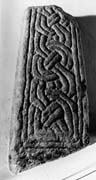
Object type: Part of cross-shaft [1]
Measurements: H. 61 cm (24 in); W. 26 > 20.3 cm (10.25 > 8 in); D. 19.7 > 15.5 cm (7.75 > 6.1 in)
Stone type: Medium-grained (with subangular grains and weak calcareous cement), very pale brown (10YR 7/3) sandstone; Middle Calcareous Grit, Coralline Oolite Formation, Middle Oxfordian, Upper Jurassic; from immediate vicinity, exposures occurring within 2 km of church
Plate numbers in printed volume: 801-803
Corpus volume reference: Vol 3 p. 207-208
(There may be more views or larger images available for this item. Click on the thumbnail image to view.)
A (broad): The lower part is undecorated. The edge moulding is worn and flat, slightly modelled in places. Within it is a plain moulding, forming the lower part of a frame for the panel. This is filled by an interlace: free rings and long diagonals; the terminal unit is bungled. The strands are extremely broad and median-incised.
B (narrow): The flat edge moulding is double. Within the panel is an undulating band in worn double outline. In its spandrels it sprouts squashed scrolls with a pellet filler beside each.
C (broad): Invisible.
D (narrow): The base is undecorated. A flat edge moulding flanks a plain inner moulding which forms the lower part of a frame to a single panel. It contains ring-twist in a broad, humped strand: four free rings and long diagonals. The lowest unit is bungled, as on face A.
This is bold, confident work using the popular Anglo-Scandinavian ring-twist. It is common throughout Yorkshire, for example, the ridges of hogbacks at Brompton, North Riding (Lang 1984a, 118–19, nos. 2–3). It is trompe d'oeuil for complex interlace. The pattern of face B is a debased spiral scroll, probably based on Anglian models, such as Hackness 1 (Ills. 454, 459), but modified by the taste for S-shaped ribbon beasts. An extension of this fusion of vegetal and faunal elements is found at Levisham (nos. 2, 5; Ills. 636, 648).
