Select a site alphabetically from the choices shown in the box below. Alternatively, browse sculptural examples using the Forward/Back buttons.
Chapters for this volume, along with copies of original in-text images, are available here.


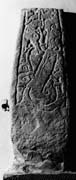
Object type: Lower part of cross-shaft [1]
Measurements: H. 80 cm (31.5 in); W. 30.5 > 22.8 cm (12 > 9 in); D. 12 > 8.3 cm (4.75 > 3.25 in)
Stone type: Medium-grained (with subangular grains and weak calcareous cement), very pale brown (10YR 7/3) sandstone; Middle Calcareous Grit, Coralline Oolite Formation, Middle Oxfordian, Upper Jurassic; from immediate vicinity, exposures occurring within 2 km of church
Plate numbers in printed volume: 804-806
Corpus volume reference: Vol 3 p. 208
(There may be more views or larger images available for this item. Click on the thumbnail image to view.)
There is entasis on the shaft, but this may be the result of preparing the foot for a socket.
A (broad): The lower third of the face is undecorated. Above this, the edge mouldings are flat, flanking a single panel which contains a fettered profile ribbon beast. Only the upper edge of the body has a double outline. The rump lies at the base of the panel, near a three-toed foot. The tail clings to the rump and interlaces with the leg to pass behind the torso and end in a scroll. On the fore leg joint and throat are thin incised scrolls. The head is domed and contains an incised circular eye. The jaws are elongated and gape, each with a horizontal slit. The lower slit has a fang; perhaps the upper one too. A fetter band which loops the torso tightly passes through the jaws and has a pair of appendage scrolls lying next to the tail's. The fore leg is bound close to the neck at the top of the panel. As a filler between the head and the rump, an animal head is viewed from above. It has a pointed snout and large pellet eyes at the side. The fettering is tight and no space is unfilled.
B (narrow): Scraped away at the lower end. A flat edge moulding flanks the underside of a profile ribbon beast with a rippled edge. An incised scroll for a leg-joint survives at the top. A filler resembling a fleur-de-lys filler occupies the spandrel at the rump by a horizontal strand. Below this is a tight scroll with broad stems, but the remaining part is damaged badly.
C (broad): Invisible.
D (narrow): The lower third is undecorated. Above it is a flat edge moulding on the right. A single panel contains the remains of a median-incised interlace, the pattern not now determinable. It has remains of two free crozier-like tendrils within the pattern, ending in tight scrolls. At the base the corner strand has a lobe and three incised transverse bars.
For the animal, see the discussion of no. 4, whose beast is more finely delineated. The animal-head filler is akin to the snake-heads on Middleton 3 (Ills. 682, 684) and Hovingham 1 (Ills. 486–9), and also to the Thames toggle (Wilson and Klindt-Jensen 1966, pl. 1). The handling of the fetters and the close grouping of terminal scrolls is directly linked with pieces at Levisham, notably the grave-cover, no. 5 (Ill. 648). This seems to be a local baroque expression, not echoed at any other sites. The crozier tendrils are unique in Ryedale sculpture. It is a common Manx motif, for example, on Gaut's cross at Kirk Michael (Kermode 1907, pl. 30) but only occurs once in Anglo-Scandinavian carvings of northern England at Lowther (no. 7 (Bailey and Cramp 1988, ills. 456, 461)). However, a bone trial-piece from the Coppergate excavations has the motif and may explain this Ryedale response to a western style (Tweddle 1980; Hall 1984, 58, fig. 57).
