Select a site alphabetically from the choices shown in the box below. Alternatively, browse sculptural examples using the Forward/Back buttons.
Chapters for this volume, along with copies of original in-text images, are available here.


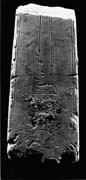
Object type: Part of stele, in two joining pieces [1]
Measurements: H. 62.5 cm (24.5 in); W. 27.3 cm (10.75 in); D. 27.5 cm (10.8 in)
Stone type: See no. 1
Plate numbers in printed volume: 82-85
Corpus volume reference: Vol 3 p. 62
(There may be more views or larger images available for this item. Click on the thumbnail image to view.)
The surface is very finely dressed. The double plain edge moulding is identical on each face of the stone.
A (broad): The base of an incised tapering cross-stem survives in the centre. The base of the stem of this cross has a narrow arris. The foot consists of a semicircular terminal containing a six-petalled half marigold.
B (narrow): This face has a vertical tooling, unlike the finely rubbed surfaces of C and D.
C (broad) and D (narrow): The finely dressed surface has the double moulding of face A.
The form of the monument is exclusive to York Minster. The incised cross with expanded semicircular terminal, however, directly relates to the incised grave-markers from Lindisfarne, Northumberland, and Hartlepool, co. Durham, (Cramp 1984, I, 97–101, 202–4). Cramp has indicated that this group, including the examples from York Minster, was produced in the period of Celtic supremacy in the Northumbrian church (op. cit., 8). Whilst the cruciform motif is Hiberno-Saxon, the later Irish examples, especially those from Clonmacnoise, co. Offaly (Macalister 1909, 31–2, pl. XXV, figs. 154–8; Lionard 1961, 133–4, figs. 24–5), are considered later than the English expressions. The York Minster series, including nos. 22–3, must relate to those from Bernician sites and be early in date.
This piece is distinctive, nevertheless, in two respects. First, the taper of the long stem of the cross, reflecting the profile of the stele itself, is rather wider than the Bernician analogues. Then, none of the Bernician or Irish crosses in the incised series has the radial petals of the York marigold. That is more closely related to Wilfridian pieces at Hexham, Northumberland, such as no. 22 (Cramp 1984, I, 186) and to the wall plaques on the Baptistery of St Jean in Poitiers (see Chap. 6, Uninhabited Scrolls). The ornament of this stele incorporates both Hiberno-Saxon and continental elements. It also points towards the development of the stele into the slimmer inscribed grave-markers such as nos. 20–1.
1. All the pieces from the Minster were discovered as a result of the excavations of 1966-71 by H. Ramm and D. Phillips. They are to be published as a handlist, together with a critical essay, in the forthcoming Royal Commission volume on the excavations. That publication will provide the finer detail of their archaeological contexts, both in a table, and in a description of the excavation of the south transept cemetery.
The following are general references to the stones: Wilson 1978, 142; Hall 1980b, 7, 21; Lang 1988b, 8, 12; Lang 1989, 5.
