Select a site alphabetically from the choices shown in the box below. Alternatively, browse sculptural examples using the Forward/Back buttons.
Chapters for this volume, along with copies of original in-text images, are available here.


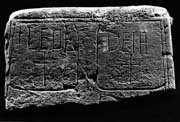
Object type: Fragment of grave-marker or stele [1] [2]
Measurements: H. 16 cm (6.3 in); W. 26 cm (10.25 in); D. 9.5 cm (3.75 in)
Stone type: Fine-grained, dolomitic, very pale brown (10YR 8/2) limestone, with small cavities; see no. 1.
Plate numbers in printed volume: 76-77, 80-81
Corpus volume reference: Vol 3 p. 62-63
(There may be more views or larger images available for this item. Click on the thumbnail image to view.)
Only one face is carved.
A (broad): A narrow, lightly modelled, plain edge moulding runs up the sides and across the top, containing an even narrower plain moulding which serves as a frame for the panel. It contains an incised cross, type B9, with straight arms, lightly curved arm-pits, and expanded ends. The lower edge of the lateral arms and all below is broken away. Above each of the lateral arms is an incised type A1 cross, with seriffed terminals, and above that is an inscription.
Inscription The letters in the remaining fields on either side of the upper limb of the cross were probably to be read together as the opening of the text (Okasha 1971, 133–4). This inscription is further discussed in Chap. 12 (pp. 00–00). The text may have continued in the lower fields, as do the texts of no. 22 and of two of the inscribed grave-markers from Hartlepool, co. Durham (Okasha 1971, 46 and 47; Cramp 1984, II, pl. 84, 436; pl. 85, 440). The inscription is in capitals which are between 3 and 3.5 cm high. They read:
+LEO[B] || DEIH
The lettering is tall and narrow. The O is a slender oblong. The D is slightly open at the top and seems to have a small and delicately cut circle at the top of its vertical stroke just below the gap. The last letter is in form an H but, to judge from eighth-century Insular manuscript usage, could perhaps have been intended as an N, or even as an eta, for Roman E (see below). The two groups of letters, if read together, would give + LEOBDEIH or + LEOBDEIN (or, conceivably, + LEOBDEIE). It presumably represented an Old English personal name. Leobdein is a possible from of Leofþegn, as Leobdeih is of Leofdaeg (Okasha 1971, 134; Searle 1897, 163, 325, 327, 333).
==J.H.
B (narrow) and C (broad): Smoothly dressed.
D (narrow): The original smooth dressing has been largely obliterated by crude diagonal hacking.
E (top): Only the plain edging adorns the smoothly dressed flat top.
The tooling and choice of stone, and probably the size of this piece, are evidence of its connection with the stelae. The slab-like section, however, distinguishes it in terms of form. Its upward taper suggests an upright posture like the better known grave-markers. In form its closest Minster parallel is no. 23. The incised cross, however, lacks the semicircular expanded terminals and circular junction, so separating it from the Hartlepool, co. Durham, and Irish series (Lionard 1961, 128–135; Cramp 1984, I, 97–101). It more nearly resembles those on the ends of the apsidal bench of Sant' Apollinare in Classe, Ravenna (Lionard 1961, pl. XXVIII, 3), or that on a grave-marker at San Vincenzo al Volturno, also in Italy (Ill. 924; see Chap. 12). Small incised crosses like those below the inscription are ubiquitous in Ireland (op. cit., 102–4, figs. 1–4) and throughout the Christian West.
Inscription The rectangular O occurs on inscriptions from Hartlepool, co. Durham, (Cramp 1984, I, 99–100, II, pl. 84, 436; pl. 85, 440), probably also on the Hackness cross (pp. 137—8; Ill. 458), and on the Ardagh Chalice, as well as in the display script of books such as the Lindisfarne Gospels, the Lichfield Gospels, and the Book of Kells (Okasha 1968, 325; Okasha 1971, pls. 46–7; Dunraven 1874, pl. L; Gógan 1932, 47–50; Alexander 1978, ills. 32, 76, 78, 253). The D looks like a compromise between capital D and uncial D. The slight gap at the top is found in uncial D in some manuscripts (Lowe 1960, passim). If the final letter is H, it is unremarkable. Other possible readings could be supported by parallels in Insular display scripts: N, as in St Gall, Stiftsbibliothek, Cod. 1395, p. 426, and in Oxford, Bodleian Library MS Auct. D.2.19, fol. 127; or Greek eta for E, as in New York, Pierpoint Morgan Library, MS M. 776, fol. 27 (Alexander 1978, ills. 148, 261, 269). As seen above, the readings of the letter as N and H both give plausible forms of recorded Old English personal names.
==John Higgitt
1. All the pieces from the Minster were discovered as a result of the excavations of 1966-71 by H. Ramm and D. Phillips. They are to be published as a handlist, together with a critical essay, in the forthcoming Royal Commission volume on the excavations. That publication will provide the finer detail of their archaeological contexts, both in a table, and in a description of the excavation of the south transept cemetery.
The following are general references to the stones: Wilson 1978, 142; Hall 1980b, 7, 21; Lang 1988b, 8, 12; Lang 1989, 5.
2. The sections on the inscription are by J. Higgitt.
