Select a site alphabetically from the choices shown in the box below. Alternatively, browse sculptural examples using the Forward/Back buttons.
Chapters for this volume, along with copies of original in-text images, are available here.


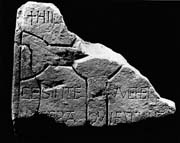
Object type: Fragment of grave-marker or stele, in two joining pieces [1]
Measurements: H. 21 cm (8.25 in); W. 25 cm (9.8 in); D. 13.3 > 12.7 cm (5.25 > 5 in)
Stone type: See no. 1
Plate numbers in printed volume: 91-94
Corpus volume reference: Vol 3 p. 64-66
(There may be more views or larger images available for this item. Click on the thumbnail image to view.)
A (broad): A very thin, slightly modelled moulding runs along the surviving left-hand edge. Abutting this moulding is the half-round expanded terminal of an incised cross, of which only one arm (type F) and part of the stem, supporting a circular junction, remain. The cross is deeply incised. Ruled across the circular junction of the cross are three vertical lines, very lightly incised, controlling the positions of the edges of the stem and the central axis. There are the remains of an inscription in all three surviving quarters of the face.
Inscription The inscription (Okasha 1971, 135) is further discussed in Chap. 12 (pp. 44–5). The three surviving lines are set in the fields flanking the incised cross (one line above and two below the cross-arms). Two of the letters in the last line intrude on to the stem of the cross. The letters are capitals and are about 1.7–1.8 cm high. The inscription is damaged and may be imperfect at the end. The language is Latin. It reads:
(upper left quadrant):
+HI[C—] || ||
(lower quadrants):
[CES.]ITE || || [V]VLFH/E[R—]
[M...R]A || [Q]V || [ESCVNT]
In the last line, the carving of the QV of QVI on the stem of the cross implies that the lines of the inscription are to be read straight across, rather than field by field as suggested by Okasha (1971, 135). The text presumably therefore continued across the stone from the upper left quadrant into the now missing upper right quadrant. If these suppositions are correct, the text can perhaps be read: + HIC [—] CES[P]ITE VVLFHER[I M...R]A QVIESCVNT. This may be translated: '+ Here [beneath this?] turf [or tomb?] rest the [—] of Wulfhere'.
==J.H.
B (narrow): Broken away.
C (broad): Smoothly dressed, with the surviving side carrying the same edge moulding as on face A.
D (narrow): This side tapers, and carries the same plain moulding as on face A. It is smoothly dressed.
The form of the cross is identical with many at Hartlepool, co. Durham (cf. no. 21). The finely incised lines on the cross are from the original laying-out of the design: see no. 1. Here the lines are ruled simply for centering and do not constitute a complete grid.
Inscription Non-Classical letter forms in this text include: A with a straight cross-bar and a bar across the top; square C; and angular S. All these are generally common in Anglo-Saxon inscriptions and all appear in pre-Viking Northumbria, for example, on the cross at Ruthwell Dumfriesshire, and in the Lindisfarne Gospels (Okasha 1968; Kendrick et al. 1960, II, 75–7, 93–4, 99–100). The form of the Q is unclear. It might perhaps have resembled an unusual early medieval continental form with an interior tail (cf. Gray 1986, 226). The suggested reading pi for Latin P in a Latin text can be matched in the (possibly Northumbrian) Gospel fragment of c. 700 (Cambridge, Corpus Christi College, MS 197B, fol. 2), as well as in the early ninth-century Mac Regol Gospels from Ireland (Oxford, Bodleian Library, MS Auct. D. 2. 19, fol. 127 (Alexander 1978, ills. 49, 269)). Pi for P also appears in the Latin lettering of the Ardagh Chalice (Dunraven 1874, pl. L; Gógan 1932, 47–50).
The text is longer than on most comparable Northumbrian grave-markers and shows signs of compression: H and E are ligatured, and F is inset within L in VVLFHER[.]. The latter device can be matched, for example, in an inscription at Jarrow, co. Durham, and in the Lindisfarne Gospels (Higgitt 1979, 360). The letters are also rather smaller than those of nos. 20–1. The pressure for space could explain why the letter-cutter has, unusually, cut two letters of the last surviving line across the stem of the cross itself. This could suggest that the inscription was a later addition (cf. Okasha 1971, 4). However, it may be later only in the sense that the letter-cutter was a different individual from the carver of the stone and its cross, or that decisions about the design of the stone and about the text of the inscription were taken separately. The monument and its text can therefore probably be considered for practical purposes contemporary.
Enough remains of the text of this monument to show that it ws an epitaph. The upper word in the lower left-hand field (CES.ITE) can be turned into a Latin word (CESPITE), if the damaged letter is reconstructed as the Greek pi. There is a slightly larger space to the right of the two verticals, which may have been accounted for by the horizontal extending further to the right than to the left: compare the asymmetrical horizontal of the pi in Cambridge, Corpus Christi College, MS 197B (Alexander 1978, ill. 49). Cespes (for Classical caespes, the literal meaning of which is turf) can be used in funerary contexts and seems by the early Middle Ages to have extended its range of possible meanings to include tombs and sepulchral monuments (De Rossi 1888, 88, 264, 267; (—) 1967–, II, 1, col. 46), although no examples of the meaning are given in the Dictionary of Medieval Latin from British Sources (Latham 1975–, II, 239). (Whether a monument rather than plain turf is meant here might depend on whether the burial referred to was in a cemetery or within a church.) What seems to be a neuter plural noun of probably six letters precedes the plural verb QVIESCVNT. The first letter was probably M and the letter before the final A could well have been R. Probably three letters are missing in the middle of the word. This would give [M . . . R]A. Two possible reconstructions, which would fit the available space, suggest themselves: membra and munera. The slight remains of the antepenultimate letter perhaps fit E better than B. It is not very clear, however, what munera would mean in this context. (The normal range of meanings of munus include 'service', 'office', 'duty', 'gift', etc. Two of its recorded uses are perhaps a little more appropriate. In Classical Latin munera can refer to pagan funeral rites and Rabanus used the word in an inscription to mean 'relics' (Duemmler 1884, 226).) The words membra quiescunt would in fact make more sense in an epitaph. They can also be found used as the ends of hexameters in at least two Early Christian epitaphs in Rome, both of which appear in a medieval manuscript collection of inscription texts (De Rossi 1888, 101, 104). The inscription might then be interpreted as 'Here [beneath this?] turf [or tomb?] rest the limbs of Wulfhere', assuming, as is likely, that the preceding name (Wulfher.) was in the genitive. The probable word-order and the use of the slightly recherché cespes may indicate that the text was metrical, perhaps a hexameter.
Wulfhere was the name of an archbishop of York (854–92 or 900) (Fryde, Greenaway, Parker and Roy 1986, 224) but, even if the inscription had been cut early in his pontificate, it would still be rather later than the date normally assigned to this group of memorial stones in Northumbria. There is, however, no necessity to connect the inscription with the archbishop.
==John Higgitt
1. All the pieces from the Minster were discovered as a result of the excavations of 1966-71 by H. Ramm and D. Phillips. They are to be published as a handlist, together with a critical essay, in the forthcoming Royal Commission volume on the excavations. That publication will provide the finer detail of their archaeological contexts, both in a table, and in a description of the excavation of the south transept cemetery.
The following are general references to the stones: Wilson 1978, 142; Hall 1980b, 7, 21; Lang 1988b, 8, 12; Lang 1989, 5.
