Select a site alphabetically from the choices shown in the box below. Alternatively, browse sculptural examples using the Forward/Back buttons.
Chapters for this volume, along with copies of original in-text images, are available here.


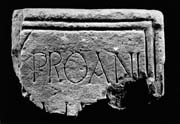
Object type: Fragment of grave-marker or stele [1] [2]
Measurements: H. 9.2 cm (3.6 in); W. 13.3 cm (5.25 in); D. 14.6 cm (5.75 in)
Stone type: See no. 1
Plate numbers in printed volume: 86-90
Corpus volume reference: Vol 3 p. 63-64
(There may be more views or larger images available for this item. Click on the thumbnail image to view.)
A (broad): There is a double, lightly modelled edge moulding of very narrow strips, the inner narrower than the outer. They pass along all the extant edges, continuing round the corner. Abutting the moulding at the top left-hand corner, in what must originally have been the middle of the stone, is the serif splay of the upper arm of a lost incised cross, indicating that it was probably of type B9. Within the mouldings and the cross-arm is part of an inscription.
InscriptionThe surviving lettering is set in what was the right-hand field flanking the upper arm of the incised cross (Okasha 1971, 133). Parts of two lines remain. The inscription presumably began in the top left-hand field and may have continued in the fields below the cross-arms. The letters are capitals and are about 2.3 cm high. The language is almost certainly Latin. The inscription is further discussed in Chap. 12 (pp. 44–6). It reads:
|| PROA[NI]
|| [—A..—]
==J.H.
B–E: All the other faces carry the double edge moulding, including the top of the shaft. They are smoothly dressed.
The survival of the top of the stone demonstrates the development of these flatter stelae carrying inscriptions from the squarer, more simply adorned variety. The presence of the moulding on all faces suggests a free-standing position, probably inside a building to judge from the condition of the dressing and lettering. The form of the cross-arm is identical with that of no. 20 and shows the same Mediterranean influence.
Inscription The opening of the text can reasonably be reconstructed as [+ ORATE] PRO ANI[MA —, that is, 'Pray for the soul of . . .'. The inscription probably opened with a cross, as do nos. 20 and 22. An introductory cross and then five letters of ORATE in the top left quadrant would balance the six of PROANI on the right better than would +ORA. The MA of ANIMA would have appeared in the second line of the left quadrant. The formula 'orate pro anima X' appears on Minster 42, as well as on two cross-shafts at Lancaster (Okasha 1971, 89–90, 133–5). There is nothing irregular about the lack of word-division between the preposition PRO and its noun ANI[MA]. ANI[MA], if that is the correct reconstruction, was split over the line-end in accordance with the rules of syllabification.
The non-Classical letter forms on 21 are A with an angular cross-bar and slightly pointed or lentoid O, both of which are forms known at Jarrow, co. Durham, around 700 (Higgitt 1979, 356, 359–60, pls. LX, LXIIa, LXVIIa).
==John Higgitt
1. All the pieces from the Minster were discovered as a result of the excavations of 1966-71 by H. Ramm and D. Phillips. They are to be published as a handlist, together with a critical essay, in the forthcoming Royal Commission volume on the excavations. That publication will provide the finer detail of their archaeological contexts, both in a table, and in a description of the excavation of the south transept cemetery.
The following are general references to the stones: Wilson 1978, 142; Hall 1980b, 7, 21; Lang 1988b, 8, 12; Lang 1989, 5.
2. The sections on the inscription are by J. Higgitt.
