Select a site alphabetically from the choices shown in the box below. Alternatively, browse sculptural examples using the Forward/Back buttons.
Chapters for this volume, along with copies of original in-text images, are available here.


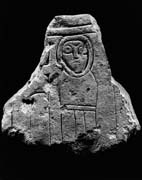
Object type: Fragment (reused stele?) [1]
Measurements: H. 20 cm (7.9 in); W. 18.7 cm (7.4 in); D. 10.2 cm (4 in)
Stone type: See no. 1
Plate numbers in printed volume: 99-102
Corpus volume reference: Vol 3 p. 66-67
(There may be more views or larger images available for this item. Click on the thumbnail image to view.)
A (broad): On the left-hand edge is a possible narrow moulding. At the top is a double moulding of very thin strips. The panel contains figural carving. Towards the right-hand edge stands a full-face, long-robed figure. His oval face has a pointed chin set within a deeply cut, modelled cowl. The modelled eyes are elliptical, sweeping into a splayed nose. He wears a thin belt at the waist, depicted by two parallel incisions. From the centre of the belt, two vertical incised lines descend in front of the long skirt. Close to the left-hand side of the figure is a long-stemmed cross with stumpy lateral arms of type A1. To the left of this is a raised arc, possibly the cowl of another figure. Below, a curving incised line sweeps towards the stem of the cross. Except for the cowl's rim, all the incisions are thin and rough.
B and D (narrow): Broken away.
C (broad) and E (top): Smoothly dressed.
The quality of the carving is rustic. It is possible that an early plain stele has been recut at a time when figure carving was in fashion, say, the ninth century. The cross flanked by figures is found on a later piece at Kirby Wharfe, West Riding (Collingwood 1915, fig. a on 205; idem 1927, 88, fig. 107). The 'cowl' could be a clumsy attempt at a rimmed halo in the manner of Norham 4A, Northumberland (Cramp 1984, II, pl. 203, 1162).
1. All the pieces from the Minster were discovered as a result of the excavations of 1966-71 by H. Ramm and D. Phillips. They are to be published as a handlist, together with a critical essay, in the forthcoming Royal Commission volume on the excavations. That publication will provide the finer detail of their archaeological contexts, both in a table, and in a description of the excavation of the south transept cemetery.
The following are general references to the stones: Wilson 1978, 142; Hall 1980b, 7, 21; Lang 1988b, 8, 12; Lang 1989, 5.
