Select a site alphabetically from the choices shown in the box below. Alternatively, browse sculptural examples using the Forward/Back buttons.
Chapters for this volume, along with copies of original in-text images, are available here.


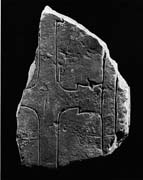
Object type: Part of cross-shaft [1]
Measurements: H. 25.3 cm (10 in); W. 19.5 cm (7.6 in); D. 18.7 cm (7.4 in)
Stone type: See no. 1
Plate numbers in printed volume: 103-106
Corpus volume reference: Vol 3 p. 67
(There may be more views or larger images available for this item. Click on the thumbnail image to view.)
A (broad): The right-hand edge has an incised double moulding. Within the panel and abutting the moulding is a narrow incised cross with rounded arm-pits. The surviving lateral arm is of type D11, but with sharp corners where the inner and terminal parts of the arm join. The beginnings of the upper terminal suggest that it was of the same type. The cross-stem is carefully ruled.
B (narrow): The narrow double edge moulding is broken. The panel contains remains of a plant-scroll with a ridged node and, above, pendant paired leaves with a bud. The cutting is incised.
C (broad): One arm of a cross, type B9 with gently curving sides and flat end, survives. The stone immediately adjacent to its profile has been deeply cut away to leave the cross in relief. The perimeter of the cross has a double outline. Immediately beyond the arm end are light incisions identical with the terminals of the incised cross on face A.
D (narrow): Broken away.
This is an important piece as it represents a transition from the incised stelae to embellished shafts bearing plant-scroll. The terminals of the incised cross have no parallel at either Hartlepool, co. Durham, or Lindisfarne, Northumberland, and it seems originally to have been the decoration on both broad faces. The cross cut in relief intrudes and is secondary. This new taste for relief sculpture brings the York Minster pieces into line with the Anglian tradition in Northumbria, exemplified in Bewcastle, Cumberland, and at Otley, West Riding (Cramp 1970, 63). The splayed cross has a close parallel in its painted counterparts on the altar of the Hypogeum in Poitiers (Hubert, Porcher and Volbach 1969, 60, pl. 73). Together with the plant-scroll, the repertoire of ornament, at both primary and secondary levels, looks to continental sources rather than to the the Hiberno-Saxon tradition. This may reflect York's aspirations to metropolitan status in the English church.
1. All the pieces from the Minster were discovered as a result of the excavations of 1966-71 by H. Ramm and D. Phillips. They are to be published as a handlist, together with a critical essay, in the forthcoming Royal Commission volume on the excavations. That publication will provide the finer detail of their archaeological contexts, both in a table, and in a description of the excavation of the south transept cemetery.
The following are general references to the stones: Wilson 1978, 142; Hall 1980b, 7, 21; Lang 1988b, 8, 12; Lang 1989, 5.
