Select a site alphabetically from the choices shown in the box below. Alternatively, browse sculptural examples using the Forward/Back buttons.
Chapters for this volume, along with copies of original in-text images, are available here.


Object type: Part of grave-marker [1]
Measurements: H. 47 cm (18.5 in); W. 34 cm (13.4 in); D. 12.2 cm (4.8 in)
Stone type: Medium-grained (with quartzite pebbles up to 6 mm), very pale brown (10YR 7/4) grit; see no. 2.
Plate numbers in printed volume: 111-114
Corpus volume reference: Vol 3 p. 67-68
(There may be more views or larger images available for this item. Click on the thumbnail image to view.)
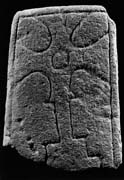
A (broad): There is a narrow plain edge moulding. This contains an incised cross, type B10 with splayed arms and narrow curved arm-pits. It has a circle at the centre, and the lower arm is perched on a slender stem, which in turn stands on a stepped base, or Calvary.
B and D (narrow): A plain edge moulding runs along the sides and top continuously.
C (broad): The edge moulding is identical with that of the other faces. The panel has a primitive cross cut in two intersecting incised lines. A circle is placed at the intersection and the ends are expanded triangles. The lower arm stands upon a stem consisting of a single line.
Whilst it resembles in several terms the cross-bearing stelae, its workmanship is crude by comparison. The stepped Calvary is unusual in pre-Conquest sculpture. It is an amateurish piece, though the mouldings are trim enough. A less ambitious version of the splayed-arm cross is found on no. 29, and both may be poor copies of accomplished relief carvings like the two grave-markers at Wensley, North Riding (Collingwood 1907, 407–8, figs. a–b on 409). More distant comparatives should be considered in Hackness 2 (Ill. 467), and Bewcastle 4, Cumberland (Bailey and Cramp 1988, ill. 127).
1. All the pieces from the Minster were discovered as a result of the excavations of 1966-71 by H. Ramm and D. Phillips. They are to be published as a handlist, together with a critical essay, in the forthcoming Royal Commission volume on the excavations. That publication will provide the finer detail of their archaeological contexts, both in a table, and in a description of the excavation of the south transept cemetery.
The following are general references to the stones: Wilson 1978, 142; Hall 1980b, 7, 21; Lang 1988b, 8, 12; Lang 1989, 5.
