Select a site alphabetically from the choices shown in the box below. Alternatively, browse sculptural examples using the Forward/Back buttons.
Chapters for this volume, along with copies of original in-text images, are available here.


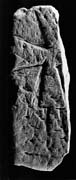
Object type: Part of grave-marker [1]
Measurements: H. 68.5 cm (27 in); W. 24.5 cm (9.6 in); D. 14.3 cm (5.6 in)
Stone type: Medium- to coarse-grained, yellow (10YR 7/6) grit; see no. 2.
Plate numbers in printed volume: 115-120
Corpus volume reference: Vol 3 p. 68
(There may be more views or larger images available for this item. Click on the thumbnail image to view.)
A and C (broad): On the rough surface there is half of an angular cross of type B6 standing on a stem. On face C the lower arm curves outwards, more like type E10. The cutting is hacked and the surface pitted.
B and D (narrow): Dressed but undecorated.
Its two decorated faces and its upright position at its discovery point to its being an upstanding monument. It also seems to pre-date the final phase of the cemetery though its ornament gives no stylistic evidence. It is very close to a slab found in York, Parliament Street 3 (Ills. 357–60), which was found associated with pre-Conquest material. Such crude slabs, like Wharram Percy 2 (Ill. 883), may be reflexes of the contemporary East Midlands slab series: for example, the grave-cover from Little Shelford, Cambridgeshire (Fox 1920–2, pl. VI).
1. All the pieces from the Minster were discovered as a result of the excavations of 1966-71 by H. Ramm and D. Phillips. They are to be published as a handlist, together with a critical essay, in the forthcoming Royal Commission volume on the excavations. That publication will provide the finer detail of their archaeological contexts, both in a table, and in a description of the excavation of the south transept cemetery.
The following are general references to the stones: Wilson 1978, 142; Hall 1980b, 7, 21; Lang 1988b, 8, 12; Lang 1989, 5.
