Select a site alphabetically from the choices shown in the box below. Alternatively, browse sculptural examples using the Forward/Back buttons.
Chapters for this volume, along with copies of original in-text images, are available here.


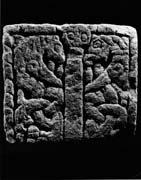
Object type: Fragment of grave-cover [1]
Measurements: L. 32.6 cm (12.8 in); W. 38.2 cm (15 in); D. 22 cm (8.7 in)
Stone type: Medium- to coarse-grained, slightly feldspathic, white to very pale brown (10YR 8/2–8/3) grit; see no. 2
Plate numbers in printed volume: 152-156
Corpus volume reference: Vol 3 p. 73
(There may be more views or larger images available for this item. Click on the thumbnail image to view.)
The fragment has been cut from a whole slab (see no. 38?).
A (top): The edge moulding is cabled and continuous, only being interrupted at the centre of the end by an animal head which faces inwards. It has incised circular eyes and an incised line across the jowl. There is a dip between the snout and the broad, flat strip issuing from it, which formed part of the cross-stem.
The panels on each side are mirror images. In each of them a York winged beast with mane, scrolled wing joint, incised elliptical eye and small ear faces inwards. Each wears a collar with a contoured edge, and has a pendant 'leaf' on the snout. The body consists of irregular interlace using contoured strands.
B–D (long sides and end): The sides have the cabled moulding as their only ornament. The long sides are finely dressed.
E (end): Broken away.
F (bottom): Plain.
Identical with no. 35. The reuse as an end-stone in the eleventh-century levels of the cemetery is attested elsewhere on the site (Lang 1978b, 151–2). This particular piece may lie behind the design of the two later end-stones, York Minster nos. 32–3 (Lang 1978b, 151–2).
1. All the pieces from the Minster were discovered as a result of the excavations of 1966-71 by H. Ramm and D. Phillips. They are to be published as a handlist, together with a critical essay, in the forthcoming Royal Commission volume on the excavations. That publication will provide the finer detail of their archaeological contexts, both in a table, and in a description of the excavation of the south transept cemetery.
The following are general references to the stones: Wilson 1978, 142; Hall 1980b, 7, 21; Lang 1988b, 8, 12; Lang 1989, 5.
