Select a site alphabetically from the choices shown in the box below. Alternatively, browse sculptural examples using the Forward/Back buttons.
Chapters for this volume, along with copies of original in-text images, are available here.


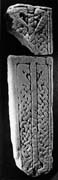
Object type: Part of grave-cover, in two nearly adjacent pieces [1]
Measurements: a: L. (max.) 53.7 cm (21 in); W. 53.7 cm (21 in); D. 14.7 cm (5.75 in); b: L. 134.3 cm (53 in); W. 51.9 > 46.7 cm (18.5 in); D. 13.3 > 10.9 cm (5.25 > 4.25 in)
Stone type: See no. 2.
Plate numbers in printed volume: 148-151
Corpus volume reference: Vol 3 p. 72
(There may be more views or larger images available for this item. Click on the thumbnail image to view.)
A (top): Fragment a, the upper end of the slab, has been cut along the upper edge of the superimposed cross which extends over the whole monument. The double edge moulding has its inner strand confined to the long sides only. The outer strip, at the end, is interrupted by an inward facing animal head which tapers slightly with incised eyes. From its jowl issues a worn, flat, upper arm of a cross. A recessed band separates the jowl from this ridge-like cross-stem.
The panels to each side are mirror images. Facing inwards is a solitary biped, its maned neck against the top edge, small ears filling the corner of the panel and its gaping jaws emitting an interlacing strand. From the snout hangs a leaf-like form with pointed tip and pendant from a stalk. The eye is elliptical. The fore leg hangs vertically against the edge moulding, implying the head is turned back, and tapers to a small foot. The wing has a scrolled joint and points downwards at an angle. The torso quickly degenerates into irregular interlace, with bifurcating strands, one strand passing under the wing. The beasts wear collars, possibly chequered.
Fragment b contains the rest of the slab with the same mouldings, and the stem and lateral arms of the superimposed cross, which are of type A12. There are small drill holes in the arm-pits of the cross. The ends of the arms have inward facing animal masks which intrude upon the edge mouldings, only the right-hand one surviving clearly. It has a single incised line on the jowl and incised circular eyes. The panels to each side of the cross-stem are filled by York winged beasts, a head at each end, and joined by their interlaced bodies whose patterns are confused in places. There are Carrick Bends here and there, and several bifurcating strands.
B–E: The sides of the slab are dressed and plain, except for rough tooling.
This slab forms part of a distinctive group, almost mass produced from Roman building blocks, which includes nos. 36–40 from the Minster, as well as identical pieces from St Mary Bishophill Junior, St Denys, and St Olave, and a related slab at All Saints Pavement. There is even an outlier, identical with Minster nos. 35–7, in co. Durham, at Gainford (no. 20) (Cramp 1984, I, 86–7, II, pl. 69, 343–6). The York winged beast does not occur elsewhere in Anglo-Scandinavian sculpture but its ancestry lies locally in the sequence which evolves from the early shaft at Otley (Collingwood 1915, 227, o, q-r), through another at Ilkley, both West Riding (ibid., 186, a). The type is well known in Anglian contexts in Mercia, from the Brunswick Casket to the shaft at Elstow, Bedfordshire (Cramp 1978, figs. 1.1.–1.2.) (see Chap. 9). Apart from the scroll-joint of the wing, there is little in the design which is diagnostically Scandinavian. The animal-head terminals of the cross should be compared with the usage in the end beasts of some hogbacks (Lang 1984a, 106–9).
The carving is accomplished and there is evidence of either templates or gridding being employed in the layout of the design.
1. All the pieces from the Minster were discovered as a result of the excavations of 1966-71 by H. Ramm and D. Phillips. They are to be published as a handlist, together with a critical essay, in the forthcoming Royal Commission volume on the excavations. That publication will provide the finer detail of their archaeological contexts, both in a table, and in a description of the excavation of the south transept cemetery.
The following are general references to the stones: Wilson 1978, 142; Hall 1980b, 7, 21; Lang 1988b, 8, 12; Lang 1989, 5.
2. In subsequent descriptions this type of animal will be termed the York winged beast (cf. Chap IX, Animal Ornament).
