Select a site alphabetically from the choices shown in the box below. Alternatively, browse sculptural examples using the Forward/Back buttons.
Chapters for this volume, along with copies of original in-text images, are available here.


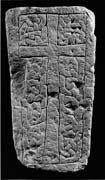
Object type: Grave-cover [1]
Measurements: L. 67.3 cm (26.5 in); W. 38.8 cm (15.25 in); D. 22.8 cm (9 in)
Stone type: Fine-grained, white (10YR 8/2) limestone; Hildenley Limestone, Coralline Oolite Formation, Middle Oxfordian, Upper Jurassic; from Hildenley, near Malton (see Fig. 5).
Plate numbers in printed volume: 171-174
Corpus volume reference: Vol 3 p. 75
(There may be more views or larger images available for this item. Click on the thumbnail image to view.)
Only the upper surface is decorated.
A (top): There is a wide, flat moulding round the perimeter, its inner edge only a roughly incised line. Within it is a large, badly drawn cross, arm type A1, deeply incised, with very slightly splayed arms. There is a tiny step at the neck of the cross. The two small square panels above the cross-arms each contains a ring-knot, somewhat bungled in the upper right panel. The long panels below contain interlace, irregularly set out: five units of half pattern A with an outside strand. The interlaces are arranged in mirror image fashion. The strands are broad and flat, leaving hardly any spaces between them.
This slab is crudely cut but made to measure for an eleventh-century child's grave. Its repertoire eschews the animal ornament of the York Metropolitan School. There has been a return to English patterns, perhaps a response to the interlace fashion in Durham (Cramp 1984, II, pl. 49, 234–6), but the skill has been lost. The dense packing of the design is inherited from Anglo-Scandinavian interlace.
1. All the pieces from the Minster were discovered as a result of the excavations of 1966-71 by H. Ramm and D. Phillips. They are to be published as a handlist, together with a critical essay, in the forthcoming Royal Commission volume on the excavations. That publication will provide the finer detail of their archaeological contexts, both in a table, and in a description of the excavation of the south transept cemetery.
The following are general references to the stones: Wilson 1978, 142; Hall 1980b, 7, 21; Lang 1988b, 8, 12; Lang 1989, 5.
