Select a site alphabetically from the choices shown in the box below. Alternatively, browse sculptural examples using the Forward/Back buttons.
Chapters for this volume, along with copies of original in-text images, are available here.


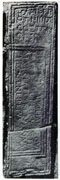
Object type: Grave-cover, in two joining pieces [1] [2]
Measurements: L. 175.5 cm (69 in); W. 48.3 cm (19 in); D. 11.4 cm (4.5 in)
Stone type: See no. 2.
Plate numbers in printed volume: 175, 181
Corpus volume reference: Vol 3 p. 75-76
(There may be more views or larger images available for this item. Click on the thumbnail image to view.)
Only the upper surface is decorated.
Inscription This slab is a reused stone, containing a primary pagan Roman funerary inscription, which is now only partially legible. A later, post-Roman, inscription has been inserted at right angles to the Roman text and in the free space to its left. It is in four lines of roughly cut capitals (Okasha 1971, 134–5). The letters are approximately 5 cm in height. The last two lines are very worn. The inscription reads:
+O[RA]TE[P]R
O[A]NI[M]A
CO[STA/VN]
C[:—]
The first two lines clearly read: + ORATE PRO ANIMA ('+ Pray for the soul of'). The third line presumably contained a personal name, which may have continued into the fourth line (COSTAVN, or COSTAVNC—).
The text opens with a cross. The lettering is irregular and unpretentious in layout and design. The alphabet is based on Roman capitals with some departures from the canon. A has a bar across the top and in the first instance the inclining strokes meet the bar without coming together to form an angle. No cross-bar is visible on the second A. M seems to be derived from a text letter rather than from display script or epigraphic lettering (see below). N is the common Early Christian and early medieval form in which the diagonal meets one or both of the verticals well short of their ends. R is open-bowed. The letter probably to be read as S seems to be the angular form ('reversed Z'). A and V appear to be linked in a ligature in the third line. There seems to have been a mid-line point after the first letter in line 4. A possible abbreviation bar hovers over the abraded lettering in line 4. The monosyllable PRO is incorrectly split over the line-end. See further Chap. 12, pp. 46-7.
==J.H.
Inscription The use of an introductory cross may be compared to nos. 20 and 22. The incorrect splitting of PRO is also found in the more refined text of Bishophill Junior 5. Of the letter forms, the form of M could be based on either the Insular half uncial or the minuscule letter, although it lacks the lead-in stroke on the left (Bischoff 1986, Abb. 13–14). A very similar M appears on a ring of about the ninth century found at Bossington, Hampshire (Okasha 1971, pl. 14; Hinton 1974, 9–12, pl. V). The lettering is not closely datable, although it is unlikely to be contemporary either with the finely cut York inscriptions of about the eighth century (nos. 20–2, Bishophill Junior 5, and St Leonard's Place 1), or perhaps with the reasonably neat lettering of the late pre-Conquest period seen, for example, at Castlegate 7, or Kirkdale 10.
The late Anglo-Saxon inscription at St Mary-le-Wigford in Lincoln is a very similar case of the reuse of a Roman inscription (Okasha 1971, pl. 73). No effort was made to disguise the previous function of the York stone. The post-Roman inscription is placed at right angles to the Roman text and in the free space to its left.
The text, which seems to have read + ORATE PRO ANIMA COSTAVN C —, is plainly memorial. The formula, as has been seen, probably occurred on no. 21. The name (Costaun, or Costaunc—), if it is a name, has not so far been identified among Old English or Old Norse names, although COS- could represent the Old English name elements Cos- or Gos- (Okasha 1971, 134). An alternative, equally uncertain, hypothesis is that *Costaun represents a British or Welsh name, being perhaps a development from Constans or Constantius: compare the development of Constantinus to Welsh Custennin, Custeint, etc. (Bartrum 1966, 44, 46, 109). [3] The inscription was presumably carved to identify the tenth- to eleventh-century burial that it covered.
==J.H.
1. All the pieces from the Minster were discovered as a result of the excavations of 1966-71 by H. Ramm and D. Phillips. They are to be published as a handlist, together with a critical essay, in the forthcoming Royal Commission volume on the excavations. That publication will provide the finer detail of their archaeological contexts, both in a table, and in a description of the excavation of the south transept cemetery.
The following are general references to the stones: Wilson 1978, 142; Hall 1980b, 7, 21; Lang 1988b, 8, 12; Lang 1989, 5.
2. The sections on the inscription are by J. Higgitt.
3. I am very grateful to my colleagues, Dr Fran Colman and Professor William Gillies, for their advice on this problematic form.
