Select a site alphabetically from the choices shown in the box below. Alternatively, browse sculptural examples using the Forward/Back buttons.
Chapters for this volume, along with copies of original in-text images, are available here.


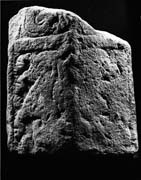
Object type: Part of coped grave-cover [1]
Measurements: L. 44.8 cm (17.6 in); W. 38.5 cm (15.2 in); D. 20.6 cm (8.1 in)
Stone type: See no. 2.
Plate numbers in printed volume: 176-180
Corpus volume reference: Vol 3 p. 76
(There may be more views or larger images available for this item. Click on the thumbnail image to view.)
The undamaged end and vertical sides of this coped grave-cover are undecorated.
A (top): The roof ridge is almost worn away but it had lateral elements running down the roof pitch to make it a cross, which is flat and plain, type A1. The eaves have cabled moulding. A panel survives on each roof pitch above the cross-arms. Each contains a standing quadruped with scrolled joint and its tail over its back. Both are very worn. Part of another panel shows curving elements of a bird or a ribbon beast with a double outline.
This seems to be a coped version of the grave-cover series and may be a reused Roman sarcophagus lid. It is small compared with the St Denys coped stone, but has the same shallow pitch (Ills. 210–11). The stance of the quadruped is unlike other animals of York. The scrolled joint and double outline are usual in the York Metropolitan School, but the upright posture and the position of the tail over the back, without entangling the body, is unusual. Single animals occupy such panels framed by a cross on the hogback from Hickling, Nottinghamshire (Lang 1984a, 140–1), which shares the coped section of the present monument.
1. All the pieces from the Minster were discovered as a result of the excavations of 1966-71 by H. Ramm and D. Phillips. They are to be published as a handlist, together with a critical essay, in the forthcoming Royal Commission volume on the excavations. That publication will provide the finer detail of their archaeological contexts, both in a table, and in a description of the excavation of the south transept cemetery.
The following are general references to the stones: Wilson 1978, 142; Hall 1980b, 7, 21; Lang 1988b, 8, 12; Lang 1989, 5.
