Select a site alphabetically from the choices shown in the box below. Alternatively, browse sculptural examples using the Forward/Back buttons.
Chapters for this volume, along with copies of original in-text images, are available here.


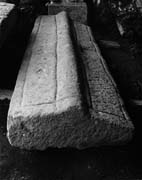
Object type: Coped grave-cover [1]
Measurements: L. 208 cm (82 in); W. 57 cm (22.5 in); D. 23.5 cm (9.25 in)
Stone type: Medium- to fine-grained, very pale brown (10YR 7/4) sandstone; perhaps Westphalian, Upper Carboniferous; possibly reused Roman ashlar, originally from Otley area (see Fig. 5)
Plate numbers in printed volume: 186
Corpus volume reference: Vol 3 p. 77
(There may be more views or larger images available for this item. Click on the thumbnail image to view.)
The coped stone has truncated ends and short vertical sides. The pitch of the roof is shallow but it is surmounted by a prominent ridge with humped section. Along the edges is a crudely incised line serving as a moulding. The line also runs at the base of the ridge. To one side of the ridge is a parallel slot.
Only its archaeological context demonstrates the date of this stone's use.
1. All the pieces from the Minster were discovered as a result of the excavations of 1966-71 by H. Ramm and D. Phillips. They are to be published as a handlist, together with a critical essay, in the forthcoming Royal Commission volume on the excavations. That publication will provide the finer detail of their archaeological contexts, both in a table, and in a description of the excavation of the south transept cemetery.
The following are general references to the stones: Wilson 1978, 142; Hall 1980b, 7, 21; Lang 1988b, 8, 12; Lang 1989, 5.
