Select a site alphabetically from the choices shown in the box below. Alternatively, browse sculptural examples using the Forward/Back buttons.
Chapters for this volume, along with copies of original in-text images, are available here.


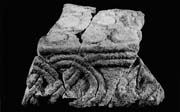
Object type: Fragments of hogback [1]
Measurements: L. 38.5 cm (15.2 in); W. 43 cm (17 in); D. 23 cm (9 in)[1]
Stone type: Fine-grained, cellular, dolomitic, very pale brown (10YR 8/2) limestone; see no. 1.
Plate numbers in printed volume: 187-189
Corpus volume reference: Vol 3 p. 77-78
(There may be more views or larger images available for this item. Click on the thumbnail image to view.)
On the shallow pitched roof of the reconstructed long side were rows of a unique type of circular tegula. The eaves are marked by a roll moulding and the vertical side below has a run of interlace of uncertain pattern: perhaps a form of simple pattern F with a glide, using median-incised strands.
The lost gable-end was vertical and had a flat, broad edge moulding containing a frontally disposed demi-figure with arms outstretched. The elbows dipped. Beneath the arm-pits were two snake heads, their ribbon bodies curling into the lower corners. The figures arms were looped by other strands. The figure had a pointed chin and the head was slightly inclined in the apex of the gable. The hands were spread.
The tegulation of this hogback is of a unique form. The shape of the monument is very close to that of some of the coped grave-covers and the connection between the two forms of grave-cover was highlighted by this piece. It should be compared with the hogback at Bedale, North Riding (Lang 1984a, 116–17, no. 2).
The interpretation of the figure on the gable lends itself to speculation. Pattison sees it as a Crucifixion (1973, 215). Coatsworth (1987, 163) cites local examples of serpents associated with the Crucifixion. In view of the Sigurð iconography of no. 34, it is possible that the scene depicts Gunnar in the snake pit. The stance of the figure, however, does have echoes of the Christ on the St Mary Castlegate cross-head (no. 2; Ill. 297). Perhaps some overlap was intended (Bailey 1980, 139). The position of the figure's arms is very reminiscent of the Crucifixion of Brigham 5, Cumbria (Bailey and Cramp 1988, ill. 144), where there is similar entangling of snake-like elements. The Irish posture no doubt affects the figure here though the restraint of the cross-head shape is absent. Bailey sees the Brigham piece in the context of the Cumbrian series of men contending with beasts, applied to Christ (op. cit., 76–7). In an area where the iconography of Sigurð is so well represented, such an interpretation surely applies to the scene on this hogback.
1. All the pieces from the Minster were discovered as a result of the excavations of 1966-71 by H. Ramm and D. Phillips. They are to be published as a handlist, together with a critical essay, in the forthcoming Royal Commission volume on the excavations. That publication will provide the finer detail of their archaeological contexts, both in a table, and in a description of the excavation of the south transept cemetery.
The following are general references to the stones: Wilson 1978, 142; Hall 1980b, 7, 21; Lang 1988b, 8, 12; Lang 1989, 5.
